
Opening up the festival with the Munich Hostage Crisis and feral Chinese dogs

I love Festival Season. As a longtime Oscar watcher and film obsessive I’d scour every trade I could to see what the hottest incoming releases were. Once I got to college and realized that the Philadelphia Film Festival was not just a local fest but, in fact, had heavy hitters, I did my damndest to attend nearly every year I was in the city. So far, it’s been the only festival I’ve had the pleasure to go to – mainly out of location and timing concerns, and thanks to being in college for all that time. PFF is as associated with fall as my own birthday, and coming back feels like home in a way.
The point of this long-winded intro is that I consider myself a pretty plugged in person, one who’s just started going to the Opening Night showings because I both have a job and have passes that make it easy to decide whether I want to or not (also helped that the last two have been American Fiction and The Banshees of Inisherin, even if I only got to see the latter). Which is to say I was a bit surprised and confused when September 5 (Grade: C+) was announced as this year’s opener because I was pretty sure I had never heard of it until then. Turns out, I had; it was at Venice and a couple other festivals. It’s not difficult to understand why it might’ve been chosen either. Set during the 1972 Munich Olympics, it follows an ABC TV crew as they stumble upon and begin reporting on the Israeli team being taken hostage by Palestinian terrorists, most famously dramatized in Steven Spielberg’s Munich.
It’s undeniably tense and often gripping, with the added pleasures of the many analog processes needed to bring live news coverage in front of television viewers (I didn’t realize that captions had to be physically made like that), and for the most part it avoids slipping into Newsroom-style “how it should’ve gone”. But at the same time, I can’t help but focus on the fact that it reduces the Palestinians to faceless terrorists, including a very creepy black and white image catching them one on a balcony. To be fair, the film is not unaware of the biases and subjectivity around such an unprecedented event. Multiple arguments occur over whether they can show someone getting shot on live television, and there’s a recurring theme of how bad it would be for Jewish people to once again die horribly on German soil. It never quite reaches the level of soul searching needed to fully fend off whatever the bad vibes, and mostly just settles for recreations. The fact that it doesn’t ever leave the control room hampers things quite a bit too, as does the relative anonymity of most of the workers save Leonie Benesch’s Marianne. Director Tim Fehlbaum was unknown before this. He’d probably be a journyman in a functioning studio system.
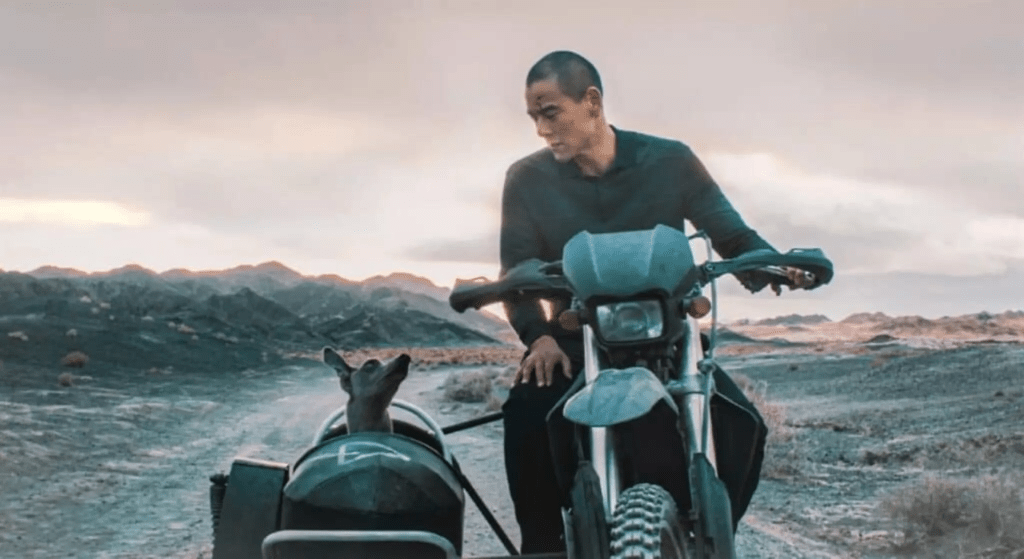
This was actually the second film I saw this day, a process that took much longer thanks to some technical problems related to the print that saw us waiting for an hour before it started. Much smoother was Black Dog (Grade: B+), this year’s Un Certain Regard winner at Cannes and boy, does it ever live up to that title. In fact it opens with a whole pack of dogs running across the Gobi Desert, in the process causing a bus to crash. That bus holds our protagonist Lang (Eddie Peng), prone to near total silence like so many Western heroes of yore. He’s been paroled and is on his way back to his decaying industrial town, set to be demolished as part of a revitalization project. Director and co-writer Hu Guan makes wonderful use of the desolate and bare landscapes; even the abandoned buildings look kind of pretty under his eye. It’s at one of these abandoned buildings that he has his first encounter with the titular creature, a vicious greyhound that’s among the many dogs left behind as their owners have picked up or faded away.
In need of money to keep a vengeful gangster off his back, Lang joins up with a dog capturing team (lead by Jia Zhangke, prominent chronicler of modern China. His Caught By The Tides is winding its way through the festival circuit to great reviews) and becomes set on capturing it. Somewhere along the way, a bond forms. The two seem to sense that they’re both trapped in cages not all of their own making, creatures that aren’t bad but just need someone to care for them. It does help that it’s a very good dog and if you’re wondering, yes, the actor – Xin – won the Palm Dog. Guan’s film may not quite cohere together on a full thematic level, at least on first brush, somehow both blunt and elusive. He’s an expert at staging set pieces, and a late one featuring a zoo jailbreak set to Pink Floyd is kind of awe-inspiring. Like its protagonist, you grow to love the thing anyways, warts and all. And if nothing else it’s an absolutely beautiful looking film.
Tomorrow: Sean Baker’s much hyped Palme winner Anora, Renate Reinsve as a single mother, and the first of many Indian films, as well as After Hours.
 Life of the Mind