And also Maria is here

Payal Kapadia’s All We Imagine As Light (Grade: A) is a frontrunner for my favorite film I’ve seen all year. Don’t know how to start this off other than just to put it plainly. There may have been no other film I’ve been anticipating all year, at least since the reviews and the Grand Prix award started coming in and it’s clear we’ve got a major talent on our hands. At turns luscious, dreamy, and poetic, Kapadia’s crafted a thing of true beauty, a grand claim for the female voice in Indian cinema.
Her previous film – 2021’s controversial documentary A Night of Knowing Nothing – featured fictional love letters read in voice over between film students interspersed with footage of protests against the Modi government, something which I’m told has gotten the film banned in a few states (and probably had something to do with why the selection committee passed it over at the Oscars, all man board notwithstanding). Here the voiceover returns and paired with the evocative nighttime shots of Mumbai, it’s transcendent – beginning first with a survey of Mumbai’s many languages describing the city, and then featuring everything from poetic dialog to text conversations.
The former centers around nurse straight-laced Prabha (Kani Kusruti). Her husband is away in Germany for work, unseen, represented by a foreign rice cooker she receives one day in the mail. In the thorough of loneliness she starts to fall into some sort of connection with a doctor at the hospital (Azees Nedumangad), though it’s clear to both that as much as they may want it, this is an impossible thing.
She lives with Anu (Divya Prahba), the source of the aforementioned text conversations. Those are for Shiaz (Hridhu Haroon), a handsome man who – more crucially – is Muslim; the forbidden nature of their romance would seem to point more towards her parents but given Modi’s current Hindu nationalist leanings, it’s not hard to read that as a comment on the country at large.
Kapadia’s political leanings don’t stop there either. The scene most reminiscent of A Night of Knowing Nothing features Parvaty (Chhaya Kadam), an older woman being threatened with eviction from her home of 22 years to make way for luxury condos, as she gathers with a group of activists. Her trip back home to her seaside village provides the ostensible plot, and it’s where the film ends in a particularly stunning shot. It can’t be overstated how beautifully shot the film is, awash in the life of the city, capturing its essence. Kusruti’s radiant performance provides the biggest emotional hook, but it’s the interplay with the actresses that provides the film with its beating heart. Here’s one that knows better than to lean into trite female celebration, instead drawing out the much deeper connections between them all, and from us.

The same can’t really be said about Maria (Grade: C), Pablo Larraín’s capper to an impromptu trilogy about the fraught lives of famous divas. In this case, the diva is Maria Callas, a woman I admittedly know next to nothing about besides the Opera and that one clip of that old queen saying he’s never heard a bad performance from her. Unfortunately you’re not going to learn much of anything about who she was or her life from this.
I rather enjoyed Jackie a lot, Spencer a little less but I still think fondly of it and Kristin Stewart’s performance. Despite also being scripted by Steven Knight, this one is rather inert, almost boring. As La Callas, Angelina Jolie captures what I assume the mannerisms of her are (and looks the part in footage shown in the credits). She never gets into a big screaming match or throws things across the room which I suppose is a small blessing for this kind of biopic. But something about the dialog just kept rubbing me the wrong way; extremely blunt and sounding performative, but with no real insight as to whether she really believes any of that or not. It’s straining to be clever in a way that the last two never reached, with so much emphasis on the distinction between Maria and La Callas but without anything in the sense of differentiation. Larraín introduces a newer stylistic track here from Jackie‘s TV special shooting and Spencer‘s haunted house perfume ad, in this case sequences of a drug-induced hallucination (?) of Kodi-Smit Mc-Phee interviewing Callas and getting precisely zero out of her. There’s lots of clips of Jolie singing and if that’s really her voice she must be commended. At worst, Maria resembles a more traditional biopic, something that could never be said about the others. It’s as if it relies too much on the audience knowing anything about Callas’ past and expecting that to carry through. A late scene featuring her sister shows the better movie hiding in there, but it’s just not enough.
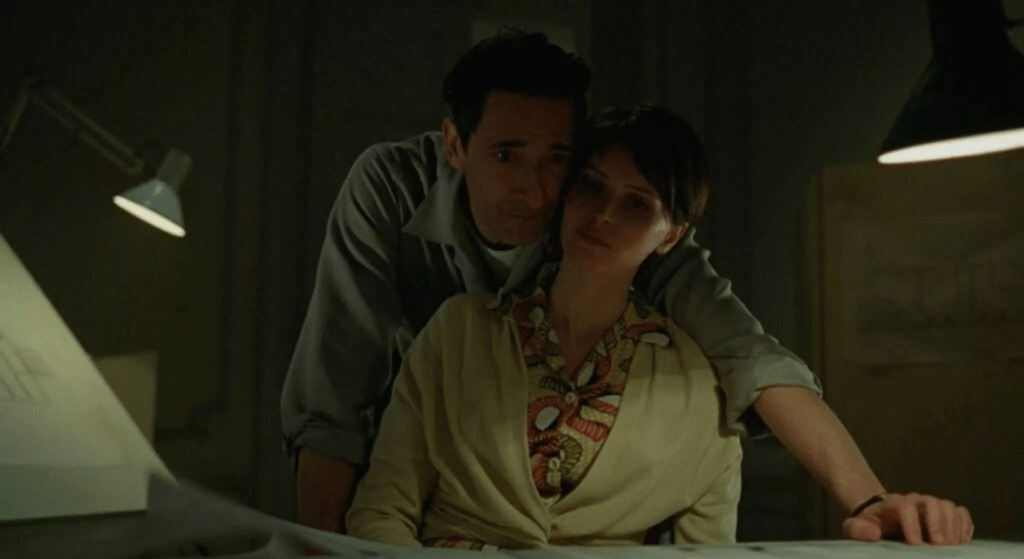
“Too little” is not a word anyone would use to describe The Brutalist (Grade: A-) – all 215 minutes + intermission of it. Brady Corbet’s – erstwhile European arthouse actor turned cold, provocative director of The Childhood of a Leader and Vox Lux – film has been described as an attempt at the Great American Novel and there’s really no other way to describe it in its epic sweep. The brutalist of the title is one László Tóth (Adrien Brody), a Hungarian architect fleeing the Holocaust to come to a little town called Doylestown in Pennsylvania (trust, that got a lot of reaction from the crowd).
Split into two acts covering roughly a couple decades, Corbet and co-writer Monica Fastvold have a lot on their mind: foreignness, Jewish people’s precarious place in society, the promise of America. Largely they mange to pull it off, and moving at quite a clip. By the time we hit the built in intermission I was certain we would be getting more chapters. Guy Pearce – as an industrialist who hires Tóth to construct a community center – injects a big dose of mid-century energy into the proceedings, pulling at threads of power and those who wield it over others. I’m not fully convinced the film has the necessary emotional power befitting of such an epic, and admittedly it does lag a bit in the interminable battle to get the center built. Still, the massive achievement of pacing itself cannot be denied, and I’m sure it will only rise in estimation once I get back around to it.

Finally, quick detour for some behind the scenes info: a big part of scheduling involves looking up US distributors, info that used to be on the program but for a few years now has not been there. If it’s from an A24, a Neon, a Mubi, etc. chances are that it will be coming to Philly, and so I feel much safer about skipping. This is part of how I found myself at the late night screening for Cloud (Grade: B+), a movie I likely would’ve seen eventually but frankly, did not want to take the chance that it would be coming a full year from now.
That aside: this is one of three or so Kiyoshi Kurosawa films in the pipeline this year (one of them, Chime, is on a Web3 platform or something) and Japan’s surprise choice for Best International. It follows Ryôsuke (Masaki Suda, the titular boy of The Boy and the Heron), a factory worker more concerned with his side hustle of reselling goods on the internet. What he’s not too concerned about is whether those goods are legitimate or whether the price he charges is fair. Naturally, this does not endear him to those he does business with, giving Kurosawa the chance to go back to the mode of Cure and Pulse that made him famous in the West. I don’t want to give away too much as to where it goes, other than to say it feels sort of like a Yakuza substory at times, perhaps one where Kiryu has to beat the shit out of someone scamming people. It may take a bit to get to the good parts, and the analysis of internet behavior may not be more than “anonymity (and money) breeds conflict”. But it’s a cracking thriller, uninterested in trying to garner sympathy for the lead but not too concerned with overly punishing him. If anything, it features a gunfight that suggests Kurosawa could make a pretty good action pivot.
Tomorrow: Mike Leigh reunites with Marianne Jean-Baptiste, Jesse and Kieran Go To Europe, and I try to make these things shorter for my own sake.

 Life of the Mind