A movie I haven’t quite been able to get out of my mind.
Ritual
The mockumentary – and, to a lesser extent, found footage – is a surprisingly underrated format when it comes to horror. Perhaps it’s due to the genre’s main association with comedies. Or perhaps the cheapness and extensibility of found footage created a default state for filmmakers. After all, why go to the trouble of drafting a world when you can just pretend someone stumbled upon this horrifying video footage (never mind the question of “who assembled this footage just so”). A true fake documentary holds greater potential, because of the nature of having to assemble something. Think Ghostwatch, where a British television special on hauntings accidentally becomes something realer. Or Lake Mungo – beloved by many, more appreciated by me – which uses a talking head format as a starting point for a ghost story.
Noroi: The Curse commits fully to its premise, presenting itself as an unreleased documentary by paranormal researcher Masafumi Kobayashi. It blends typical documentary footage and in person interviews along with archival footage of variety shows and news reports, all shot on 2005 era video cameras with the according VHS tracking from old tapes. Perhaps it’s just my love of analog horror in general, but I do think found footage and mockumentaries of this nature lose a little something when the quality is too good. Recent found footage films like Gonjiam: Haunted Asylum enhance themselves with corruption or streaming drops where the audio continues while video freezes. The goal in my mind is to look like something conceivably made outside of a studio, save for the clips used from live television. Seen today, the quality of the footage makes things look even eerier, in part because it feels “realer” in a way.
Of course, aesthetics aren’t everything. You can only do so much with low quality cameras and shaky audio before you actually need to provide a story. And this is where Koji Shirashi’s film shines. Initially, we appear to be following three different unrelated tracks: there’s a woman named Junko Ishii who’s neighbors are unnerved by her and her son. There’s Kana Yano, a girl with seemingly legitimate psychic abilities demonstrated on variety shows. Finally, there’s the actress Marika Matsumoto (the voice of Rikku in Final Fantasy X!) – playing herself – who has a terrifying encounter at a shrine.
It Slowly, Shirashi and co-writer Naoyuki Yokata begin connecting the strands. There’s a man named Matsuo Hori, a psychic also suffering from some form of mental illness, who had dealings with both Kana and Marika. Strange loops make begin to appear, as do a creepy looking mask. Kobayashi begins to research a demon named Kagutaba, and the trail of death following Junko Ishii, all leading back to a village and a ritual that has gone wrong. While a little long and perhaps prone to highlighting the creepy things in the background (something that could be explained as just Kobayashi’s style), the film casts an unnerving feeling throughout. Once the stories begin intersecting, a sense of dread starts to enter, and it builds it up slowly but steadily. It’s riveting as you put the pieces together, and Shirashi’s style cultivates a genuine feeling of authenticity. There are no winks to the camera, no cheats in the concept. It builds to a finale hinted at in the beginning that explodes in horrifying power, leaving you completely unsettled. If nothing else, you’ll never see masks – or hear a baby’s cry – the same way again.
Spoilers for Audition, but if you’re reading this you probably already know what’s up. Additionally: Spooktober will take the form of 4 posts about horror films I really love (because a post a day was far too ambitious). Look forward to them!
Audition is a film about deception. There’s, of course, the thrust of the inciting incident of the narrative itself: a producer holding a fake audition to find the perfect wife. More infamously, there’s the structure of the film itself: at this point it’s probably more known for starting out as a serene Japanese drama before suddenly shifting into gory horror. Takashi Miike’s breakthrough film doesn’t exactly lie to the audience, and neither does the marketing. But through near total restraint and careful pacing, Miike and screenwriter Daisuke Tengan take protagonist Aoyama’s ignorance of red flags and implant it into the audience themselves. There are signs sprinkled all throughout that things are not what they appear to be. The fatal flaw is that the characters would rather live in the lie than get off the path to ruin.
Talking about Audition is naturally a little bit hard, but at this point the ending is as infamous as Psycho‘s first grand kill. It’s essentially impossible to view it in it’s pure, first time format unless – as Mike D’Angelo suggested – you hand someone an unmarked DVD containing the film and nothing else and have them watch it right there. In broad strokes, the film is about a widowed producer, Shigeharu Aoyama (Ryo Ishibashi), who – with prodding from his friend – holds a fake casting audition to find himself the perfect wife. He finds this in Asami (Eihi Shiina), who at first appears to be everything he could ask for. There’s just something “off” about her…
Having advanced knowledge actually presents quite an interesting shift in viewing – one that probably occured for all who were familiar with Miike before this film: surprise at how un-Miike like it is. Miike has of course directed over 100 films at this point, ranging from bizarre and violent to family-friendly; in the West – perhaps due to the inherent publicity from controversy over the most extreme of them – he’s famous for violence and a slightly hyper-active style. Audition, by contrast, stays almost completely rooted in a rather naturalistic and quiet mood for the first half or so. This is the key to the whole thing working, and the key to the film itself. Just after the titular audition scene, Aoyama is contacted by another worker, who reveals some mildly troubling news: he can’t seem to find any of the references Asami has left on her application. This is a rather mild slip, but Miike consciously shoots it as an omen of things to come. Time and time again, Aoyama is given an out: his friend even explicitly tells him that something about Asami unnerves him and that it would be a bad idea to continue things further.
Both Aoyama and Asami are, in some ways, lying to themselves as much as they lie to each other. Aoyama would rather believe in the non-existent perfect wife, despite the many deeply troubling signs. Asami – to a lesser extent – is willing to believe him when he says that he will love only her (it’s unclear whether she knows at this point of both his son and his dog). Seen from this angle, Aoyama’s punishment in the finale almost comes across as justified for his hubris: he’s unwilling to believe Asami is anything other than perfectly compliant and submissive, that she could ever be capable of violence until she finally turns it back on him.
Perhaps the greatest deception of all is that Audition is “torture porn”. On the one hand, it’s easy to believe given how infamous (and graphic) the finale is. Strangely enough, that finale is actually kind of bloodless if you compare it to something like Hostel, with all its guts and gore spilling across the place. It helps that Shiina underplays Asami’s psychopathy: she calmly straps herself into an apron, preparing her surgical field with deadpan efficiency. Her manner of speech is as if she’s just administering punishment, not revenge (a point for the “it’s all in his head” team). This isn’t to say there’s no blood, but rather compared to Miike’s reputation, it actually feels somewhat realistic for the actions taken. He even cuts away from the needles entering Aoyama’s eyeballs, letting us see Asami and imagine for ourselves what’s happening.
Miike has never made another film like this, though he surely has it in him from a formal perspective. What makes it so effective after all these years is the sheer nature of it as a deceptive film, tying us back to the characters themselves. We can wish all we want that it’ll end at him waking up, that someone will make different decisions, that it was all just in his head. Reality won’t let that happen, and as Aoyama does, we accept the punishment for thinking things could end any other way.
Kicking off a month of horror with a modern masterpiece
On the hunt
An attempt to publish an article on a horror movie everyday this month, starting with one that may not be “pure”, but is just as unsettling.
Alien perspectives are hard to imagine. We only have ourselves as a frame of reference for what extraterrestrial life could be like, nothing except for our previous interactions with each other to go off of. Despite a limitless imagination, science fiction – when introducing sapient life – tends to default to what we believe is the proper “form” for what living beings should be. With a few small changes, aliens generally tend to behave like foreign countries interacting with each other: a base line familiarity of social interactions and biological functions. But how can we properly depict alien perspective if we can’t even escape our own?
Jonathan Glazer’s Under The Skin is perhaps the first film to truly attempt to answer this question. Its first hour is an assault of images and noise – attempt to learn human speech, English as it sounds to someone who doesn’t understand, the atonal droning and skittering of Mica Levi’s iconic score. This is not the view of someone divorced from reality or alienated (for lack of a better word) from humanity, but someone fundamentally inhuman at their core, intrigued and perturbed by what they see.
The main character has no name but is perfectly embodied by Scarlett Johansen. Her looks and demeanor are key to the whole thing working, with great subtlety in her actions and choices that may not reveal themselves on first glance. Take the various scenes in which she lures men into her void in part by taking off her clothes: she never makes any sort of pose or movement that could be defined as “sexy”. Her body language – while relaxed – remains stiff. She isn’t attempting a seduction so much as mimicking the concept; one could easily imagine her having read or been briefed on the idea, after which she goes through the motions, not because she understands what it is but because she’s been told it’s the best way to gather her prey. Most importantly is the complete lack of emotion she displays all throughout the first half (other than confusion or interest).
This is put to especially disturbing effect when she comes across a foreign swimmer attempting to save a couple who have ran into the sea to recover their dog. When he washes up after a failed attempt, she takes a rock and smashes his head with it, dragging him off to her lair while we’re left with the crying of the couple’s abandoned baby. There’s no manipulation on her part (other than the basic amount needed to convince people she’s normal); it’s best described as a crime of opportunity, the rest simply just noise to her task. We never get a direct explanation or description of what she thinks of her prey. At most we see a fascination with them, a curiosity bordering on amusement that nonetheless is unable to fully comprehend the subject at hand. Unlike most alien invasion stories, in which the assimilation is pretext for taking over the world, she is a hunter, finding game to transport. There’s no malice, no belief that her race is superior to humans (except, perhaps, in the fact that she’s harvesting them in the first place). Her behavior is fundamentally unknowable because we humans are fundamentally unable to imagine a being who doesn’t at least share a little simlarity with our way of thinking. Even as she seemingly abandons her mission – troubled by one particular attempt who chillingly describes the feeling of sinking – and begins maybe identifying with humanity, she never fully gets it. In the end, she’s still mimicking it, until by the end she’s a wild animal, unable to understand why this is happening but reacting on instinct.
It should be noted that none of this is stated within the film itself. Glazer adapted it from a Michael Farber book of the same name, which explicitly makes her an alien who’s goal is to harvest humans in a metaphor for factory farming; in doing so, he jettisoned basically any sort of identifying characteristics or clarity from the story and the characters. That actually enhances the material a lot, even though it’s no longer really an adaptation. By turning almost completely to imagery, Glazer has left the metaphor a lot more open, if you indeed choose to view the film through a symbolic or metaphorical lens. Perhaps the greatest strength of removing any sort of “depth” – as it were – is that all you have left is the experience of the main character. You’re left with a character who feels unknowable, impossible to connect to but who’s behavior still retains some sense of logic and reasoning. In reducing the story to its base elements, the humans themselves become little more than animals, hunting and preying.
Under The Skin would probably be a masterpiece just on a pure audiovisual level. There is truly, simply, nothing on earth like it, and there will never be anything else comparable. It is perhaps cinema as an aesthetic tool, first and foremost; a work that wants to submerse you within a strange new perspective and give you an experience you’ve never had before. One could pull various symbolic threads – the reverse predation of men and women, animal farming, existence itself, and on and on, and none of those would be wrong. But what sticks with me most at the end, are the images. The sound of a baby crying on a cold, stony beach, its parents washed away by the water. An inky black room, into which men are lured and sink into the abyss. Discordant strings and bare percussion highlighting your unease. It may not be a “conventional” horror film, in that it tries to be scary. But through a series of unnerving sequences, and fear of this person, it reaches a new level of unease and consciousness.
I didn’t “get” Paul Thomas Anderson’s The Master the first time I saw it. Or rather, I don’t think I really possessed the skills to appreciate it. My first time was in high school, circa 2014 or so, which was right around when I was really getting into film seriously and checking out lists. I remember drafting an email to Filmspotting because I’d heard them talk enough about it, and asking what it all meant (they were kind enough to respond, so shoutout to them); it wasn’t so much that I thought it was pretentious but that it felt like an series of scenes disconnected from each other, without much meaning. Teenage me really struggled to put it together – and separating it across two nights probably didn’t help much either.
Perhaps it’s one of those movies you need to watch a second time. Perhaps going through college – and also watchingquite a lot more films – exposed me to more similar structures. Maybe I just went in with a much open mind, not high off the refrains of “masterpiece” and “Best of the decade”. It might even be that I was mistakenly primed to expect a movie about Scientology, or a two-hander featuring a villainous Philip Seymour Hoffman. Whatever the reason was doesn’t matter anymore. Because now? I get it.
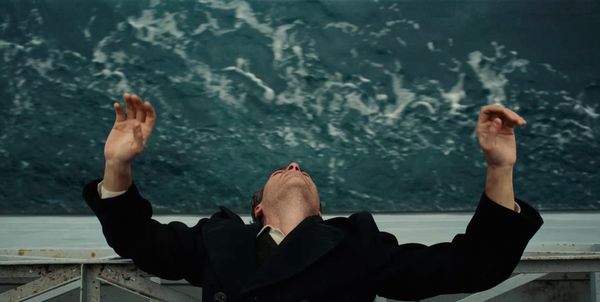
The Master is – in my mind at least – best thought of as a character study of one very specific, very damaged man, Freddie Quell (Joaquin Phoenix). It’s a lot more linear than I remembered it being; while there are some flashbacks (and one moment that takes place solely in his mind), everything you see on screen appears to be pretty much exactly what’s occurring. At first, I actually thought it was about World War I and was going to slot it into the grand theory that “All Works Involving World War I Are About How Fucked Up It Was” before being reminded that no, it’s about the Second one; specifically, the immediate aftermath. One of the key scenes takes place just after we here the announcement of the surrenders on a radio: all the soldiers lining up in formation, traveling up some stairs to hear a speech from a commander. He essentially tells them that the war is over, and they’re going to be reintegrated into society. Civilians will not understand what they’ve been through; it’s possible no one ever will. Crucially, there is no offer of help for these men. These are the ones without prominent injuries, the “normal” ones. They have been through drastic reshapings of their entire personalities, turned into killers, and yet the military expects them to become normal functioning members of society despite having seen the absolute worst that humanity is capable of. Ironically, that’s not too far off from the treatment of veterans in World War I, or even the treatment of veterans today. How can anyone be expected to be normal when your entire state of being has been so altered?
For Freddie, this may have been an impossible task even if he hadn’t been on the frontlines. His first on-screen appearance sees him mimicking sex with a sandwoman, discussing how to get rid of crabs; during a psych eval, he sees every single Rorschach image as genitalia. Soon it will become apparent that he is likely not joking about that. Even if you don’t fully connect with the film as a whole, Phoenix’s performance is still a wonder to witness, with his peculiar way of talking out the side of his mouth, his jerky movements. As charming as he’s capable of being, there’s always the feeling that Freddie is just moments away from violence. This – combined with his habit of borderline poisoning himself – gets him fired from one job and chased off of another.
He quite literally stumbles across salvation in the form of Lancaster Dodd, who’s daughter is getting married on a boat Freddie drunkenly runs to after accidentally poisoning a farmworker. While Dodd – of course – is based off L. Ron Hubbard, I think going in with that knowledge may warp your understanding of who he is. Philip Seymour Hoffman’s performance isn’t menacing, per say, nor does it appear to be overly indebted to the father of Scientology. On some level, he’s performing, yes. But watching it again, I feel that Dodd isn’t anything less than completely genuine about his beliefs, or at least his desire to help people. Does he really believe he met Freddie in a past life, as he claims? Does it necessarily matter? Either way, Freddie’s addition to their party comes not from a desire for conversion, but rather because Dodd wants more of his noxious concoctions.
None of that means that Dodd isn’t also an extremely harmful and manipulative presence. The much praised initial Processing scene shows Freddie subjected to a series of questions that soon begin falling into disturbing and highly personal details (much like the way Scientology collects blackmail material). It’s perhaps telling that Freddie at first finds the process “fun”: at first they merely consist of odd questions like “do you linger at bus stations for pleasure” and “are you thoughtless in your thoughts”. In their article proclaiming it the best scene of the year, the AV Club describes it as “designed to break down a subject’s psyche and offer a kind of euphoric relief from his or her problems.” That part comes when Dodd starts asking him about where his parents are (dead and institutionalized), if he’s killed anyone (Japanese in War and possibly the worker), and – most shocking – if he’s had sex with any of his family members (his aunt, 3 times). At the end, Freddie’s crying, perhaps finally having gotten the burden of his sins off his chest. It’s telling that Dodd doesn’t offer him judgement on any of this; he doesn’t ever bring it up even in the climactic jail scene fight. As questionable as these methods are, does it really matter if people find a sense of healing through them?
As great as this scene is, there’s actually a later moment that I found to be the key to unlocking the film for me. The Cause is at a house in Philadelphia (owned by Laura Dern!); Freddie’s “therapy” has begun in earnest through an exercise in which he walks across the room and touches the wall, describing it, then walks to the window and repeats. Dodd makes him do this over, and over, and over. This is about when Freddie has begun to disturb other members of The Cause including Dodd’s wife Peggy, and his daughter Elizabeth through sexual overtures and violent outbursts. Doubt seems to be spreading within Freddie as well, even though he remains devoted to The Cause. The exercise stretches on as Freddie gets more and more frustrated, until the members break for lunch and he ends up slipping into describing the conditions of the frontlines with each pass from the window to the wall. In this moment, it becomes clear that The Master is pretty much all about the various traumas Freddie has been repressing to his overall detriment. It’s the start of when Peggy begins to seed the idea that Freddie is beyond the help of The Cause, maybe even beyond help in general.
That’s the most fascinating idea in the whole film, the thing that keeps it from being a straight up Scientology take down. Lancaster’s efforts are genuine – even if he claims that they can cure leukemia, among other things. He can see that Freddie is in turmoil. But even a sketchy pseudo-religious movement has to recognize when to cut their losses. In the rapidly changing society of post-war America, people are fumbling around for any sort of authority, any meaning out of the violence that’s been done to them. But how do you move on from this trauma when violence and dysfunction is the only thing you’ve ever known?
The world has changed a lot since 2014. I’ve changed a ton. I wasn’t fully aware of how much the military is about forcing someone to change their entire socialization. I hadn’t yet learned about how traumatized WWI left everyone. Perhaps most relevant, I hadn’t experienced films that were content to let you puzzle out their meaning, extract symbols from shots, let the explicit be implicit. The Master, more than anything, asks a lot out of you simply by following it’s own rhythms, its own psyche of sorts. It’s a mood that can feel impenetrable at first, but reveals a wealth of substance once you open up. I have a feeling I’ll be revisiting There Will Be Blood soon. Having acknowledged they’re both character studies rather than battles – and without the latent contrarianism – feels freeing, like a new period of growth. I can’t wait to experience it.



 Life of the Mind