PFF33 Day Three: A Slew of Centerpieces (Including One of the Best of the Year)

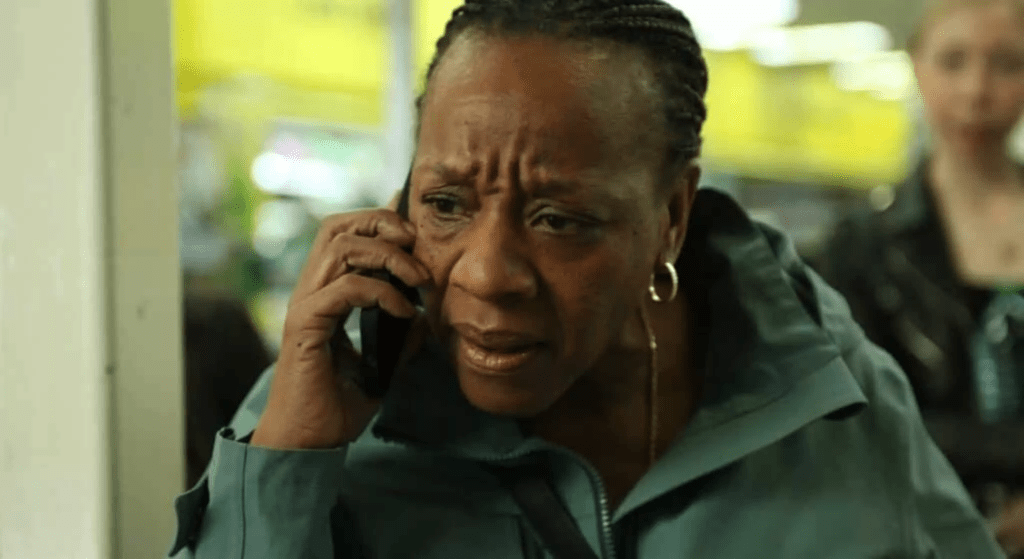
And also Maria is here

All We Imagine As Light. Credit: Janus/Sideshow

Payal Kapadia’s All We Imagine As Light (Grade: A) is a frontrunner for my favorite film I’ve seen all year. Don’t know how to start this off other than just to put it plainly. There may have been no other film I’ve been anticipating all year, at least since the reviews and the Grand Prix award started coming in and it’s clear we’ve got a major talent on our hands. At turns luscious, dreamy, and poetic, Kapadia’s crafted a thing of true beauty, a grand claim for the female voice in Indian cinema.

Her previous film – 2021’s controversial documentary A Night of Knowing Nothing – featured fictional love letters read in voice over between film students interspersed with footage of protests against the Modi government, something which I’m told has gotten the film banned in a few states (and probably had something to do with why the selection committee passed it over at the Oscars, all man board notwithstanding). Here the voiceover returns and paired with the evocative nighttime shots of Mumbai, it’s transcendent – beginning first with a survey of Mumbai’s many languages describing the city, and then featuring everything from poetic dialog to text conversations.

The former centers around nurse straight-laced Prabha (Kani Kusruti). Her husband is away in Germany for work, unseen, represented by a foreign rice cooker she receives one day in the mail. In the thorough of loneliness she starts to fall into some sort of connection with a doctor at the hospital (Azees Nedumangad), though it’s clear to both that as much as they may want it, this is an impossible thing.

She lives with Anu (Divya Prahba), the source of the aforementioned text conversations. Those are for Shiaz (Hridhu Haroon), a handsome man who – more crucially – is Muslim; the forbidden nature of their romance would seem to point more towards her parents but given Modi’s current Hindu nationalist leanings, it’s not hard to read that as a comment on the country at large.

Kapadia’s political leanings don’t stop there either. The scene most reminiscent of A Night of Knowing Nothing features Parvaty (Chhaya Kadam), an older woman being threatened with eviction from her home of 22 years to make way for luxury condos, as she gathers with a group of activists. Her trip back home to her seaside village provides the ostensible plot, and it’s where the film ends in a particularly stunning shot. It can’t be overstated how beautifully shot the film is, awash in the life of the city, capturing its essence. Kusruti’s radiant performance provides the biggest emotional hook, but it’s the interplay with the actresses that provides the film with its beating heart. Here’s one that knows better than to lean into trite female celebration, instead drawing out the much deeper connections between them all, and from us.

Maria. Credit: Netflix

The same can’t really be said about Maria (Grade: C), Pablo Larraín’s capper to an impromptu trilogy about the fraught lives of famous divas. In this case, the diva is Maria Callas, a woman I admittedly know next to nothing about besides the Opera and that one clip of that old queen saying he’s never heard a bad performance from her. Unfortunately you’re not going to learn much of anything about who she was or her life from this.

I rather enjoyed Jackie a lot, Spencer a little less but I still think fondly of it and Kristin Stewart’s performance. Despite also being scripted by Steven Knight, this one is rather inert, almost boring. As La Callas, Angelina Jolie captures what I assume the mannerisms of her are (and looks the part in footage shown in the credits). She never gets into a big screaming match or throws things across the room which I suppose is a small blessing for this kind of biopic. But something about the dialog just kept rubbing me the wrong way; extremely blunt and sounding performative, but with no real insight as to whether she really believes any of that or not. It’s straining to be clever in a way that the last two never reached, with so much emphasis on the distinction between Maria and La Callas but without anything in the sense of differentiation. Larraín introduces a newer stylistic track here from Jackie‘s TV special shooting and Spencer‘s haunted house perfume ad, in this case sequences of a drug-induced hallucination (?) of Kodi-Smit Mc-Phee interviewing Callas and getting precisely zero out of her. There’s lots of clips of Jolie singing and if that’s really her voice she must be commended. At worst, Maria resembles a more traditional biopic, something that could never be said about the others. It’s as if it relies too much on the audience knowing anything about Callas’ past and expecting that to carry through. A late scene featuring her sister shows the better movie hiding in there, but it’s just not enough.

The Brutalist. Credit: A24

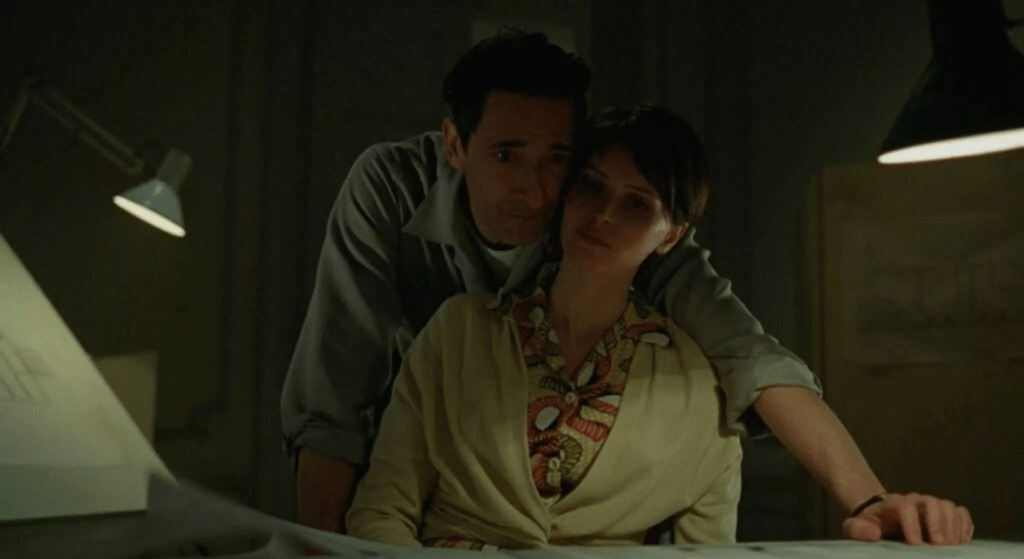
“Too little” is not a word anyone would use to describe The Brutalist (Grade: A-) – all 215 minutes + intermission of it. Brady Corbet’s – erstwhile European arthouse actor turned cold, provocative director of The Childhood of a Leader and Vox Lux – film has been described as an attempt at the Great American Novel and there’s really no other way to describe it in its epic sweep. The brutalist of the title is one László Tóth (Adrien Brody), a Hungarian architect fleeing the Holocaust to come to a little town called Doylestown in Pennsylvania (trust, that got a lot of reaction from the crowd).

Split into two acts covering roughly a couple decades, Corbet and co-writer Monica Fastvold have a lot on their mind: foreignness, Jewish people’s precarious place in society, the promise of America. Largely they mange to pull it off, and moving at quite a clip. By the time we hit the built in intermission I was certain we would be getting more chapters. Guy Pearce – as an industrialist who hires Tóth to construct a community center – injects a big dose of mid-century energy into the proceedings, pulling at threads of power and those who wield it over others. I’m not fully convinced the film has the necessary emotional power befitting of such an epic, and admittedly it does lag a bit in the interminable battle to get the center built. Still, the massive achievement of pacing itself cannot be denied, and I’m sure it will only rise in estimation once I get back around to it.

Finally, quick detour for some behind the scenes info: a big part of scheduling involves looking up US distributors, info that used to be on the program but for a few years now has not been there. If it’s from an A24, a Neon, a Mubi, etc. chances are that it will be coming to Philly, and so I feel much safer about skipping. This is part of how I found myself at the late night screening for Cloud (Grade: B+), a movie I likely would’ve seen eventually but frankly, did not want to take the chance that it would be coming a full year from now.

That aside: this is one of three or so Kiyoshi Kurosawa films in the pipeline this year (one of them, Chime, is on a Web3 platform or something) and Japan’s surprise choice for Best International. It follows Ryôsuke (Masaki Suda, the titular boy of The Boy and the Heron), a factory worker more concerned with his side hustle of reselling goods on the internet. What he’s not too concerned about is whether those goods are legitimate or whether the price he charges is fair. Naturally, this does not endear him to those he does business with, giving Kurosawa the chance to go back to the mode of Cure and Pulse that made him famous in the West. I don’t want to give away too much as to where it goes, other than to say it feels sort of like a Yakuza substory at times, perhaps one where Kiryu has to beat the shit out of someone scamming people. It may take a bit to get to the good parts, and the analysis of internet behavior may not be more than “anonymity (and money) breeds conflict”. But it’s a cracking thriller, uninterested in trying to garner sympathy for the lead but not too concerned with overly punishing him. If anything, it features a gunfight that suggests Kurosawa could make a pretty good action pivot.

Tomorrow: Mike Leigh reunites with Marianne Jean-Baptiste, Jesse and Kieran Go To Europe, and I try to make these things shorter for my own sake.

PFF33 Day Two: Sean Baker’s Grand Return

Plus the first of many Indian films, and the craziest of the festival so far

That one screenshot from Anora. Credit: NEON

There was probably no film more anticipated this year than Sean Baker’s Anora (Grade: A), at least judging from the packed house I barely made it into. That would still be the case even if it hadn’t won the Palme D’Or this year (incidentally: pretty sure this is the first time the Palme winner has been in a Centerpiece slot and not in a side section in a hot minute); since breaking through with 2015’s madcap iPhone-shot Tangerine, Baker has only gained in prominence and in filmmaking prowess. The Florida Project and Red Rocket were both previous PFF entries, as well as movies I like to love a whole lot for both their sunbleached visuals and the uproarious laughs.

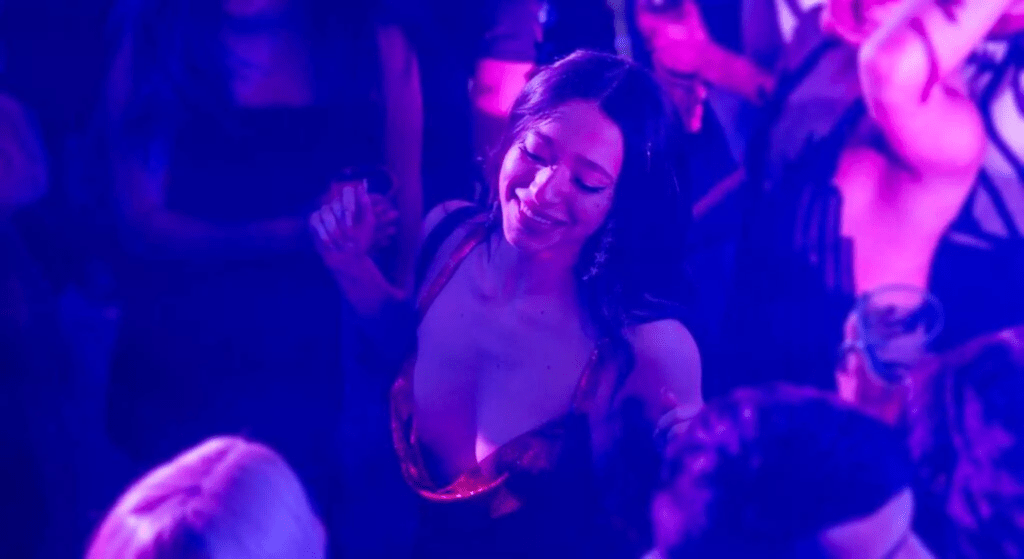
Anora is much of the same in some ways. For one, it’s the fourth in an unintentional series of films spotlighting sex workers, in this case the titular Ani (Mikey Madison), who works at a New York strip club. The shift to a relatively more dreary environment hasn’t stopped Baker from drenching the screen in color, awash in the neon lights as we follow Ani dance and hustle through a regular night of lapdances and parties. At first that seems like it’ll be the routine when Ivan (Mark Eydelshteyn) – or Vanya – walks in. Over a series of the quick-cut montages reminiscent of Red Rocket’s many sex scenes it moves into a private meet up, and then a girlfriend experience, until suddenly the two are married in a Vegas church (entirely sober, mind you). This is depicted less as a sort of romance than it is a bit that both decided to get into because why not? Ani scoffs at the initial proposal but we’ve seen her enchanted by Vanya’s luxurious lifestyle courtesy of his (potentially) oligarchical father and hey, they do seem to have fun together. That is not how Vanya’s family sees it and reality comes crashing in with the arrival of some Armenian associates (Karren Karagulian and Vache Tovmasyan, plus Yura Borisov), hellbent on annulling the marriage.

The film is by no means boring or lackluster in its first act. Eydelshteyn makes some particularly hilarious physical choices (ie, a backwards somersault on a bed) that – combined with his boyish charm – make you see what Ani might. But it’s once things all go to hell that Madison lights off the firecracker of her performance, turning into something of a hellcat. She’s effortlessly funny throughout, exasperated and confused, dropping off “fucks” like it’s her job. And yet there’s also some fear (of who these randos are and what she’s gotten herself into), and something like a desperation to hold onto the fairytale of a life with Vanya. Like all of Baker’s protagonists, she’s a real, flawed person, trying to make her way through this mess of a life, clawing her way out of desperation. I don’t know if I’d say it’s his best yet (I need to rewatch Tangerine and The Florida Project); what I can say is that Baker’s successfully controlled the chaos that’s often popped up into something more entertaining than stressful. He also lets the audience have a big cheer moment, before immediately undercutting it in truly devastating fashion. For whatever faults he may have – inside and outside filmmaking – here’s someone dedicated to showing the full spectrum of humanity, warts and all.

Armand. Credit: IFC Films

I didn’t plan it but today was a pretty women-centric day, at least onscreen. One of those women was Renate Reinsve, most famous for her Cannes winning role in The Worst Person In The World (a PFF30 entry!). She’s had something of a productive year in both Handling The Undead (Sundance, unseen by me) and A Different Man (one of the year’s best). Her third – that’s made it to the U.S. at least – is Armand (Grade: B/B+), Camera D’Or winner at Cannes (aka: best debut). In a shift from the younger focus of some of her characters, she plays Elisabeth, a single mother and actress called to a meeting at her son’s school where she learns he’s been accused of committing a heinous act against another child.

The details of said act are sketchy; only one child’s side is known, and no one else appears to have actually seen what took place. Further complicating things is her relationship to the parents of the other child (Ellen Dorrit Petersen and Endre Hellestveit), as well as her own struggles and issues, most clearly seen when she uncontrollably breaks into laughter for several minutes before segueing into sobbing.

If Elisabeth’s name and occupation didn’t raise any eyebrows, then knowing that director and writer Halfdan Ullmann Tøndel is the grandson of Ingmar Bergman and Liv Ullmann certainly raises the spector of Persona (not unfounded, thanks to the focus on two women and encroaching psychological breakdown). Tøndel possesses some definite technical brilliance at least, contributing to very recent subgenre of “movies shot like horror that are not horror”. He wrings tension out of a malfunctioning fire alarm (ignored warning signs?) and deeply unnerving sound design that seems to emphasize every step that echoes in the empty school. Unfortunately, he decides to take it into a more surreal direction, not quite verging into explicit horror but diverging enough from the drama template to break the spell a little. At almost 2 hours, it’s maybe a bit too long, but Reinsve is an absorbing screen prescence, and there’s at least some meat on the bones for a good while.

This year, PFF is spotlighting Indian film through a whole section, and my goal is to try to catch all of them at the fest. The first of these is Girls Will Be Girls (Grade: B-/B), a coming-of-age story directed by Shuchi Talati. It follows Mira (Preeti Panigrahi), a girl who’s just been made head prefect at her boarding school in the Himalayan Hills, as she begins a tentative romance with Sri (Kesav Binoy Kiron), a new boy from overseas. The main conflict comes in the form of her more traditional mother Anila (Kani Kusruti, also from this year’s All We Imagine As Light) forbids the relationship but has no issue becoming close to Sri herself.

Talati’s camera makes good use of the landscapes, but I found the film itself rather slight. There’s the seedings of themes of womanhood, of the patriarchy in India, of the changing times (it appears to be set in the 90s) and a later scene makes a slight tonal twist that emphasizes what being a girl means for Mira, for the most part it’s rather understated. The plot as a whole is sort of meandering, unified mainly by the romance which is rather cute. It’s pleasant – which, there are worse things to be – but missing some kind of spark perhaps. Maybe I’m just being too harsh on it.

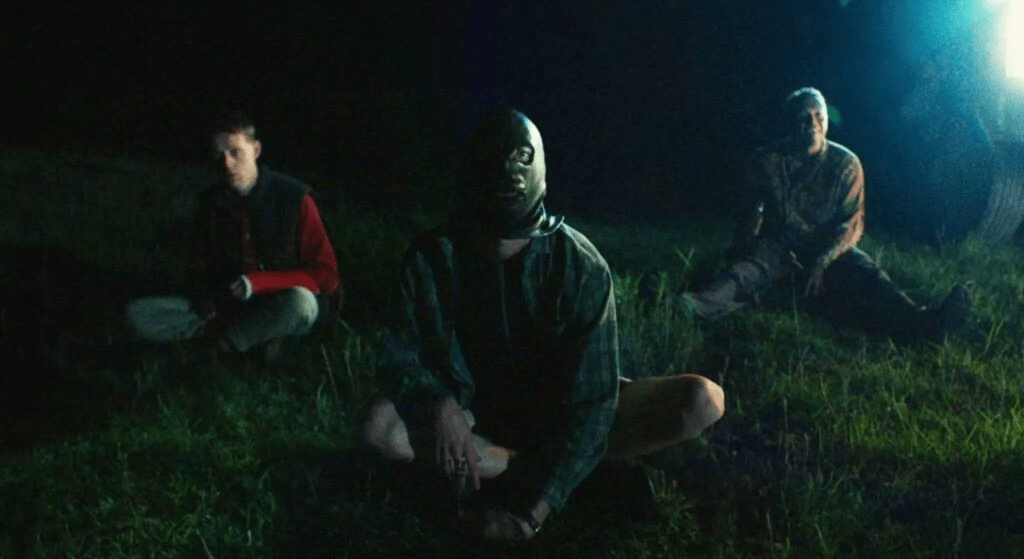
“Harsh” may as well be one of the words to describe Birdeater (Grade: B+/A-), so far the most “girl what the FUCK is happening????” film I’ve seen at the fest so far. “Unclassifiable” is another one. Jack Clark and Jim Weir’s debut has a simple enough premise – a man invites his fiancee to his bachelor party in the Australian wilderness – that gives one a certain impression of how things might go; Clark and Weir certainly do, judging from the prominence of a poster for Wake In Fright, perhaps the most famous “bad things happen in Australia” film next to Wolf Creek.

It’s not so much what happens, though a dinner scene features a revelation so out-there it sends the entire party into a tailspin. No, Birdeater is a truly demented construction of almost jazz-like editing – with score to match! – and a tone that occasionally feels like an Aunty Donna sketch. There’s some truly dread-inducing shots, like a truck driving off into the vast darkness, but it’s never quite “scary”. “Dread-inducing” feels proper, as it reveals itself to not so much be about toxic masculinity (though of course, that features in) so much as it appears to pull at the fragile stability of straight relationships. It’s telling that the one person who seems completely normal is the lone bisexual out of the cast. I may just be easily wowed by technical prowess and pretty images, of which there are plenty. Birdeater deserves marks for sheer audacity if anything else. You kind of have to respect something this destabilizing on a such a formal level, as fractured as the psychologies of the characters.

Tomorrow: One of my most anticipated movies of the year, Payal Kapadia’s All We Imagine As Light, plus Brady Corbet’s Great American Epic The Brutalist, Pablo Larraín’s Maria, and the latest from Kiyoshi Kurosawa

PFF33 Day One: SNAFUs and a Very Good Dog

Opening up the festival with the Munich Hostage Crisis and feral Chinese dogs

September 5. Credit: Paramount Pictures

I love Festival Season. As a longtime Oscar watcher and film obsessive I’d scour every trade I could to see what the hottest incoming releases were. Once I got to college and realized that the Philadelphia Film Festival was not just a local fest but, in fact, had heavy hitters, I did my damndest to attend nearly every year I was in the city. So far, it’s been the only festival I’ve had the pleasure to go to – mainly out of location and timing concerns, and thanks to being in college for all that time. PFF is as associated with fall as my own birthday, and coming back feels like home in a way.

The point of this long-winded intro is that I consider myself a pretty plugged in person, one who’s just started going to the Opening Night showings because I both have a job and have passes that make it easy to decide whether I want to or not (also helped that the last two have been American Fiction and The Banshees of Inisherin, even if I only got to see the latter). Which is to say I was a bit surprised and confused when September 5 (Grade: C+) was announced as this year’s opener because I was pretty sure I had never heard of it until then. Turns out, I had; it was at Venice and a couple other festivals. It’s not difficult to understand why it might’ve been chosen either. Set during the 1972 Munich Olympics, it follows an ABC TV crew as they stumble upon and begin reporting on the Israeli team being taken hostage by Palestinian terrorists, most famously dramatized in Steven Spielberg’s Munich.

It’s undeniably tense and often gripping, with the added pleasures of the many analog processes needed to bring live news coverage in front of television viewers (I didn’t realize that captions had to be physically made like that), and for the most part it avoids slipping into Newsroom-style “how it should’ve gone”. But at the same time, I can’t help but focus on the fact that it reduces the Palestinians to faceless terrorists, including a very creepy black and white image catching them one on a balcony. To be fair, the film is not unaware of the biases and subjectivity around such an unprecedented event. Multiple arguments occur over whether they can show someone getting shot on live television, and there’s a recurring theme of how bad it would be for Jewish people to once again die horribly on German soil. It never quite reaches the level of soul searching needed to fully fend off whatever the bad vibes, and mostly just settles for recreations. The fact that it doesn’t ever leave the control room hampers things quite a bit too, as does the relative anonymity of most of the workers save Leonie Benesch’s Marianne. Director Tim Fehlbaum was unknown before this. He’d probably be a journyman in a functioning studio system.

Xin and Eddie Peng in Black Dog. Credit: The Seventh Art Pictures

This was actually the second film I saw this day, a process that took much longer thanks to some technical problems related to the print that saw us waiting for an hour before it started. Much smoother was Black Dog (Grade: B+), this year’s Un Certain Regard winner at Cannes and boy, does it ever live up to that title. In fact it opens with a whole pack of dogs running across the Gobi Desert, in the process causing a bus to crash. That bus holds our protagonist Lang (Eddie Peng), prone to near total silence like so many Western heroes of yore. He’s been paroled and is on his way back to his decaying industrial town, set to be demolished as part of a revitalization project. Director and co-writer Hu Guan makes wonderful use of the desolate and bare landscapes; even the abandoned buildings look kind of pretty under his eye. It’s at one of these abandoned buildings that he has his first encounter with the titular creature, a vicious greyhound that’s among the many dogs left behind as their owners have picked up or faded away.

In need of money to keep a vengeful gangster off his back, Lang joins up with a dog capturing team (lead by Jia Zhangke, prominent chronicler of modern China. His Caught By The Tides is winding its way through the festival circuit to great reviews) and becomes set on capturing it. Somewhere along the way, a bond forms. The two seem to sense that they’re both trapped in cages not all of their own making, creatures that aren’t bad but just need someone to care for them. It does help that it’s a very good dog and if you’re wondering, yes, the actor – Xin – won the Palm Dog. Guan’s film may not quite cohere together on a full thematic level, at least on first brush, somehow both blunt and elusive. He’s an expert at staging set pieces, and a late one featuring a zoo jailbreak set to Pink Floyd is kind of awe-inspiring. Like its protagonist, you grow to love the thing anyways, warts and all. And if nothing else it’s an absolutely beautiful looking film.

Tomorrow: Sean Baker’s much hyped Palme winner Anora, Renate Reinsve as a single mother, and the first of many Indian films, as well as After Hours.

33rd Philadelphia Film Festival Coverage Starts Tomorrow

A slightly different tack for reporting on Da Movies™

Credit: Philadelphia Film Society

A lot can change in the course of a year. For instance: last year at this time I was still employed, my uncle had just died, and my plans for that year’s Film Fest were scuttled both due to a small concert planning mishap and said death. Not to mention feeling a bit disappointed at the lineup that year – most of the high profile ones had either already released (Anatomy of a Fall, Killers of the Flower Moon) or were being held back for some unknown reason (The Zone of Interest, May/December).

Cut to this year: my job dissolves in November but wow, are the movies great. Which is all to say that today marks the official start of the 33rd Philadelphia Film Festival, aka the moment when my best of list gets filled out. This year is already an embarrassment of riches with the Philadelphia premieres of Anora and The Brutalist but factor in the new Mike Leigh, Payal Kapadia, Steve McQueen, Andrea Arnold, etc etc? Well… scheduling was a bit of a nightmare to say the least. I actually had to buy a badge for the first time this year thanks to demand which means I can now attempt to try every centerpiece plus opening and closing (a small blessing in disguise) and barring a few social events or exhaustion, my plan is once again to squeeze as many movies as I can in front of my eyeballs.

To that end, the purpose of this post. I’m gonna try something I wanted to do last year but couldn’t thanks to aforementioned personal issues, wherein I’ll do a daily recap/rundown of everything I saw in the style of The Dissolve and The AV Club‘s dispatches. The plan is to put up a post the next day with small(ish) reviews, ending with the usual top 10 or so when the festival ends. I will do my absolute best to put it up in a timely fashion – say, the morning of or afternoon – but I’m only human and, because I’m doing this on my vacation time, delays may occur.

All said, I’m pretty excited for this year. Some hard cuts may have had to happen but I’m confident those will come around sooner or later. If everything is as good as the hype has been, the year end list is going to be an absolute ordeal. I can’t wait. Hope you’ll follow along!