
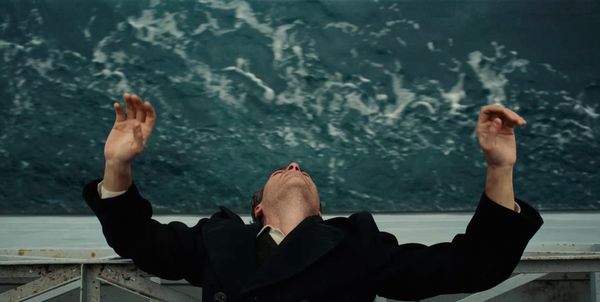
When you’re too young to comprehend a film.
I didn’t “get” Paul Thomas Anderson’s The Master the first time I saw it. Or rather, I don’t think I really possessed the skills to appreciate it. My first time was in high school, circa 2014 or so, which was right around when I was really getting into film seriously and checking out lists. I remember drafting an email to Filmspotting because I’d heard them talk enough about it, and asking what it all meant (they were kind enough to respond, so shoutout to them); it wasn’t so much that I thought it was pretentious but that it felt like an series of scenes disconnected from each other, without much meaning. Teenage me really struggled to put it together – and separating it across two nights probably didn’t help much either.
Perhaps it’s one of those movies you need to watch a second time. Perhaps going through college – and also watching quite a lot more films – exposed me to more similar structures. Maybe I just went in with a much open mind, not high off the refrains of “masterpiece” and “Best of the decade”. It might even be that I was mistakenly primed to expect a movie about Scientology, or a two-hander featuring a villainous Philip Seymour Hoffman. Whatever the reason was doesn’t matter anymore. Because now? I get it.
The Master is – in my mind at least – best thought of as a character study of one very specific, very damaged man, Freddie Quell (Joaquin Phoenix). It’s a lot more linear than I remembered it being; while there are some flashbacks (and one moment that takes place solely in his mind), everything you see on screen appears to be pretty much exactly what’s occurring. At first, I actually thought it was about World War I and was going to slot it into the grand theory that “All Works Involving World War I Are About How Fucked Up It Was” before being reminded that no, it’s about the Second one; specifically, the immediate aftermath. One of the key scenes takes place just after we here the announcement of the surrenders on a radio: all the soldiers lining up in formation, traveling up some stairs to hear a speech from a commander. He essentially tells them that the war is over, and they’re going to be reintegrated into society. Civilians will not understand what they’ve been through; it’s possible no one ever will. Crucially, there is no offer of help for these men. These are the ones without prominent injuries, the “normal” ones. They have been through drastic reshapings of their entire personalities, turned into killers, and yet the military expects them to become normal functioning members of society despite having seen the absolute worst that humanity is capable of. Ironically, that’s not too far off from the treatment of veterans in World War I, or even the treatment of veterans today. How can anyone be expected to be normal when your entire state of being has been so altered?
For Freddie, this may have been an impossible task even if he hadn’t been on the frontlines. His first on-screen appearance sees him mimicking sex with a sandwoman, discussing how to get rid of crabs; during a psych eval, he sees every single Rorschach image as genitalia. Soon it will become apparent that he is likely not joking about that. Even if you don’t fully connect with the film as a whole, Phoenix’s performance is still a wonder to witness, with his peculiar way of talking out the side of his mouth, his jerky movements. As charming as he’s capable of being, there’s always the feeling that Freddie is just moments away from violence. This – combined with his habit of borderline poisoning himself – gets him fired from one job and chased off of another.
He quite literally stumbles across salvation in the form of Lancaster Dodd, who’s daughter is getting married on a boat Freddie drunkenly runs to after accidentally poisoning a farmworker. While Dodd – of course – is based off L. Ron Hubbard, I think going in with that knowledge may warp your understanding of who he is. Philip Seymour Hoffman’s performance isn’t menacing, per say, nor does it appear to be overly indebted to the father of Scientology. On some level, he’s performing, yes. But watching it again, I feel that Dodd isn’t anything less than completely genuine about his beliefs, or at least his desire to help people. Does he really believe he met Freddie in a past life, as he claims? Does it necessarily matter? Either way, Freddie’s addition to their party comes not from a desire for conversion, but rather because Dodd wants more of his noxious concoctions.
None of that means that Dodd isn’t also an extremely harmful and manipulative presence. The much praised initial Processing scene shows Freddie subjected to a series of questions that soon begin falling into disturbing and highly personal details (much like the way Scientology collects blackmail material). It’s perhaps telling that Freddie at first finds the process “fun”: at first they merely consist of odd questions like “do you linger at bus stations for pleasure” and “are you thoughtless in your thoughts”. In their article proclaiming it the best scene of the year, the AV Club describes it as “designed to break down a subject’s psyche and offer a kind of euphoric relief from his or her problems.” That part comes when Dodd starts asking him about where his parents are (dead and institutionalized), if he’s killed anyone (Japanese in War and possibly the worker), and – most shocking – if he’s had sex with any of his family members (his aunt, 3 times). At the end, Freddie’s crying, perhaps finally having gotten the burden of his sins off his chest. It’s telling that Dodd doesn’t offer him judgement on any of this; he doesn’t ever bring it up even in the climactic jail scene fight. As questionable as these methods are, does it really matter if people find a sense of healing through them?
As great as this scene is, there’s actually a later moment that I found to be the key to unlocking the film for me. The Cause is at a house in Philadelphia (owned by Laura Dern!); Freddie’s “therapy” has begun in earnest through an exercise in which he walks across the room and touches the wall, describing it, then walks to the window and repeats. Dodd makes him do this over, and over, and over. This is about when Freddie has begun to disturb other members of The Cause including Dodd’s wife Peggy, and his daughter Elizabeth through sexual overtures and violent outbursts. Doubt seems to be spreading within Freddie as well, even though he remains devoted to The Cause. The exercise stretches on as Freddie gets more and more frustrated, until the members break for lunch and he ends up slipping into describing the conditions of the frontlines with each pass from the window to the wall. In this moment, it becomes clear that The Master is pretty much all about the various traumas Freddie has been repressing to his overall detriment. It’s the start of when Peggy begins to seed the idea that Freddie is beyond the help of The Cause, maybe even beyond help in general.
That’s the most fascinating idea in the whole film, the thing that keeps it from being a straight up Scientology take down. Lancaster’s efforts are genuine – even if he claims that they can cure leukemia, among other things. He can see that Freddie is in turmoil. But even a sketchy pseudo-religious movement has to recognize when to cut their losses. In the rapidly changing society of post-war America, people are fumbling around for any sort of authority, any meaning out of the violence that’s been done to them. But how do you move on from this trauma when violence and dysfunction is the only thing you’ve ever known?
The world has changed a lot since 2014. I’ve changed a ton. I wasn’t fully aware of how much the military is about forcing someone to change their entire socialization. I hadn’t yet learned about how traumatized WWI left everyone. Perhaps most relevant, I hadn’t experienced films that were content to let you puzzle out their meaning, extract symbols from shots, let the explicit be implicit. The Master, more than anything, asks a lot out of you simply by following it’s own rhythms, its own psyche of sorts. It’s a mood that can feel impenetrable at first, but reveals a wealth of substance once you open up. I have a feeling I’ll be revisiting There Will Be Blood soon. Having acknowledged they’re both character studies rather than battles – and without the latent contrarianism – feels freeing, like a new period of growth. I can’t wait to experience it.
 Life of the Mind