PFF33 Day Eleven: Baseball and Stolen Artifacts Close Out A Great Fest

Plus: the 10 Best Films seen.

My viewing habits finally caught up with me, as did the looming specter of joblessness. As I’ve mentioned before, in the past I’d usually become rundown by this point, powered as I was by caffeine and black-and-white cookies before the ownership changed. I think part of it was the nature of the scheduling as well: given how long a lot of the films were this year, there’s not a whole lot of time left, which in turn limits what’s programmed. Even if I hadn’t been able to do another 5-film-day, I still ended with a couple decent to pretty good films.
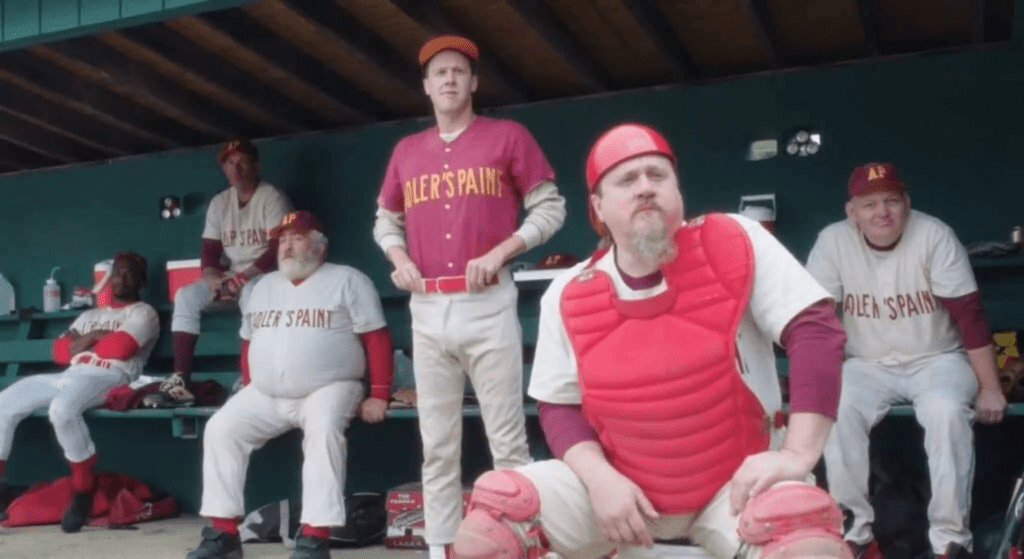
Eephus. Credit: Music Box Films

Starting off with the good was Carson Lund’s Eephus (Grade: A-). I probably wouldn’t have seen it if one-time editor Vikram Murthi hadn’t praised it on Twitter; sports are not really my thing, and I only really started watching them at all once I realized I could see them in the gay bar (because, you know… Men™). Turns out you don’t really need to know much of anything about baseball. The mechanics of the game aren’t as important as the fact that it gives the men an excuse to gather and memorialize their preferred field before a school is built on it. Lund is best known as a cinematographer, most notably with No-Budge stalwart Tyler Taormina. He caries the same sort of relaxed, slightly deadpan energy one associates with such films.

Which isn’t to say it isn’t screamingly funny, ie a man hitting a pitch and then immediately faceplanting on the ground. Much of that humor comes through in the banter and background dialogue as the men razz each other, complain about the drive to Duster’s Field, and overall mourn the passing of time. As the game stretches on, you get the sense that none of them really want to stop playing, if only because that means the friendship gets dissolved. Truth be told, you also start to feel the length of the game as it goes on. Lund keeps it easy-going, cutting between people around the ballpark and the players in free-flowing plot, so when actual tension starts to rise up it harshes the mellow a bit. What remains is the pleasure of seeing these men interact with each other, their good-nature camraderie, the sheer love of the game even if they aren’t very good at it. Like the pitch that gives the film its title, time seems to be suspended for a bit before it starts up again. And hey, like a wiseman once said: everything dies baby, that’s a fact. But maybe everything that dies, some day comes back.
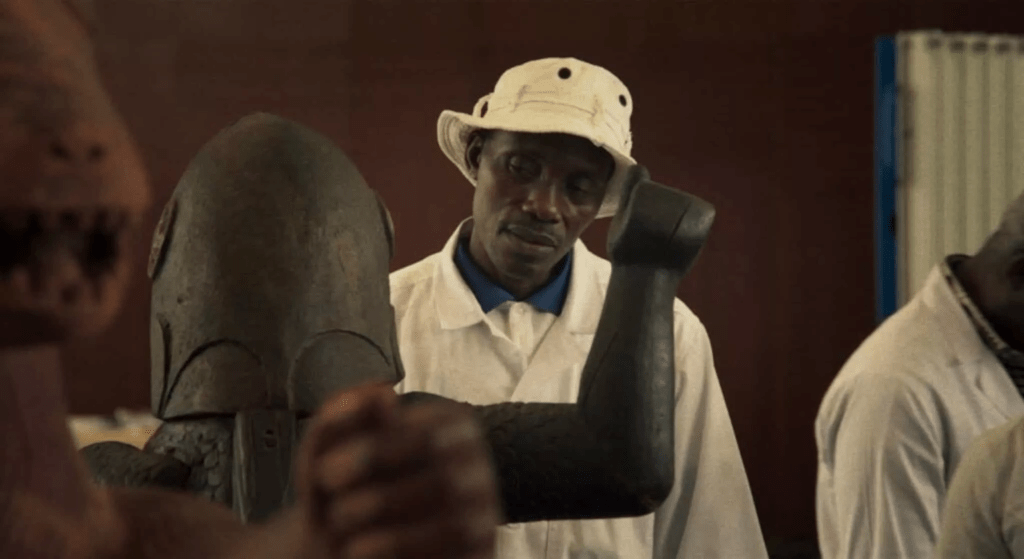
Dahomey. Credit: MUBI

“Things coming back” is the ostensible subject of the last movie I saw at the Festival, Mati Diop’s Berlin-winning documentary Dahomey (Grade: B-). The name refers to the African kingdom – now the Republic of Benin – that has recently repatriated 26 artifacts taken during French colonial rule. Part of the documentary is a fictionalized narration of the objects themselves, telling the story of their theft and return. The other half revolves around a debate with university students, in which they discuss the fact that 7,000 objects reside in the Paris museum, and they’ve only gotten this many back through years of diplomacy.

I saw Diop’s first film – Atlantics – back at the 29th Fest when I was in college; I think it closed my festival experience then too. Maybe I need to stop doing that, because much like that one, this just kind of washed over me. It’s not without its pleasures (the music, from Wally Badarou and Dean Blunt, for instance), and Diop does have talent. But I would’ve preferred the narration for every object, or at least a greater focus on their travel from France to Benin. As enlightening and lively as the university discussion is, it takes up quite a bit of a 67-minute movie. I could feel myself getting on the wavelength for it before it dissipated. Perhaps more exposure to this type of thing is needed.

And with that, the 33rd Philadelphia Film Festival has come to a close. By my count, I saw the most I’ve ever seen at one of these, at 38. Having an entire week off will do that to you. I can’t forget my badge situation as well though; not having to pay for Centerpiece tickets meant that I took a lot more chances on entires I would have otherwise ignored. This year still felt strange to me, in that the schedule somehow felt lighter than it had in years past. Not sure if that’s because there were more films here, longer runtimes, less from the vaults, however you wanna play it. Hard to remember how you felt or what you were doing 2 years ago, after all.

What I can confirm is what many of the programming staff said about this being the best one yet. By quality alone, I saw some truly stellar productions, most of my most anticipated films living up to the lofty festival hype. The biggest regret is that I had to miss The Seed of The Sacred Fig, and am now at the mercy of NEON to play it in Philly; I also had to miss Sister Midnight, the last entry in the Focus On India section, so I hope that gets a release somewhere. As I tabulated the list, I found a lack of surprise. Most everything I loved was something I’d heard of before or had put on my watchlist ages ago. There was no Red Rooms, no Tremors, or Rose Plays Julie, ie something that came from out of nowhere to completely knock my socks off. I don’t know if that was just a testament to the year or my own evolving critical tastes (or at least an attempt to hold back on crowning something just as I come out of the theater). All that said, making a top 10 was somewhat difficult. Many of these will be strong Best of The Year contenders, if not this year than the next. There are still quite a few I saw at the full list, which you can check out at Letterboxd. With the caveat that these could shift on later viewings, here’s The 10 Best Films of the 33rd Philadelphia Film Festival:

  1. All We Imagine As Light
    Still currently my favorite thing I’ve seen all year. Payal Kapadia’s rapturous feature debut is the kind of movie you just want to sink into, absorb every sensual texture and image. She turns the landscapes of Mumbai into something like a dream and in the process enhances the loneliness present everywhere. At the risk of cliche, it’s pure poetic cinema.
    Opening 11/15 in NY and LA via Sideshow and Janus, expansion likely
  2. Nickel Boys
    Out of the story of two boys at a Florida Reform School, RaMell Ross crafts a stone cold stunner. More than anything, he crafts what it feels like to hold back memories, the associations one creates from disparate moments and references that bind themselves to your trauma. Evocative but not explicit, it’s a major accomplishment and a fine work of adaptation.
    Opening 12/13 in limited release via MGM and Amazon
  3. Flow
    Easily the best animated movie of the year on sheer visual spectacle. But it’s a triumph of visual storytelling, utilizing the full scope of body language and tone to give animals character without making them human. Makes you wish you could show it to every Hollywood studio and force them to be better.
    Opening 11/22 in limited release via Sideshow and Janus, 12/6 in wide release
  4. Anora
    The most borderline one, but the late act sells it for me. Whatever Sean Baker’s politics, there’s no denying he sees such a wide vein of empathy in his title character; all he’s ever wanted was for us to understand them, and he does through his typical mix of the profanely funny. Mikey Madison is going to change gay speech patterns for years to come. Just watch that trailer and try to say “a FRAUD marriage?!” any other way.
    Out now in limited release, expect an expansion
  5. No Other Land
    “Important” is the among the lowest forms of praise you can give a movie, but if anything deserves it, it’s this. Shamefully, there’s still no legal way to see it in the US, more than likely because it refuses to act as though people can’t come to conclusions for the things they see in front of their eyes. To quote the man outside my screening: “The people that need to see this won’t.” Upsetting, harrowing, yet undoubtedly the work of filmmakers wishing for the world to see the beauty of their humanity.
    No US distributor as of this writing.
  6. Dead Talent’s Society
    Sometimes, you just have a lot of fun with a movie. I’ll admit to being a little seal-like in my joy of seeing an extended Perfect Blue reference. It helps that the rest of the movie is committed to goofy, cartoony jokes and fairly clever in using scares as a metaphor for filmmaking. A little heart goes a long way.
    Current international plans unknown. Expect it to come over next year, if not on streaming
  7. The Brutalist
    Adrian Brody, Guy Pierce, and Felicity Jones turn in fantastic performances but the true star is Brady Corbet. He effortlessly corales power, the fantasy of America, Jewish alienation, the Holocaust, and so much more into a surprisingly brisk, There Will Be Blood style epic on one man’s quest to stake his name. The fact that a movie that looks as good as this – from the sets to the costumes, down to the camera movements and compositions – for $10 million is an indictment to every actor and producer working in Hollywood today. Utterly overwhelming, and yet intensely compelling.
    Opening 12/20 in limited release
  8. Birdeater
    Truth be told I’m a little nervous to revisit this, for fear the spell will be broken. I still don’t want to give too much away from this singularly demented creation, still the most insane thing I saw at this festival. Utilizing editing and framing almost as an attack, Jack Clark and Jim Weir plunge you deep into a singularly anxious mind and then constantly pull the rug out, veering from surreality to comedy back to relationship drama and horror. Maybe the substance isn’t quite there. I gotta hand it to them for making what feels like the most unstable movie I’ve ever seen (and I mean that entirely as a compliment).
    US release unknown. Out in Australia
  9. The Order
    It might boil down to standard “cops and robbers” but what well-wrought cops and robbers these are. For whatever lack of depth (and copaganda, if you feel it) may be present on the cop side, the robbers – in this case, white supremacist terrorists – get an utterly chilling treatment that their charisma can’t hide. As much as we tell ourselves it’s done, the words of Quiz Kid Donnie Smith ring-out over the climax of The Turner Diaries: “we may be through with the past, but the PAST ain’t through with us”.
    Opening 12/6 in limited release
  10. Night Call
    The more I’ve talked about it, the more I’ve come around to this taut thriller’s ending. Michiel Blanchart wrings every bit of tension he can from his setpieces, but notice the protagonist’s relationship with the BLM protestors. Uncommonly smart when it comes to its character’s actions, ultimately unsparing as the circle closes in around him. It might be the movie I’m most looking forward to revisiting, and I hope it captures more attention when it releases.
    No date set, acquired by Magnet Releasing, should be limited within the next year
PFF33 Day 10: Penultimate Day Brings “The End”, But Not The End

A couple highlights, one dud, a disapointment, and a throwback.

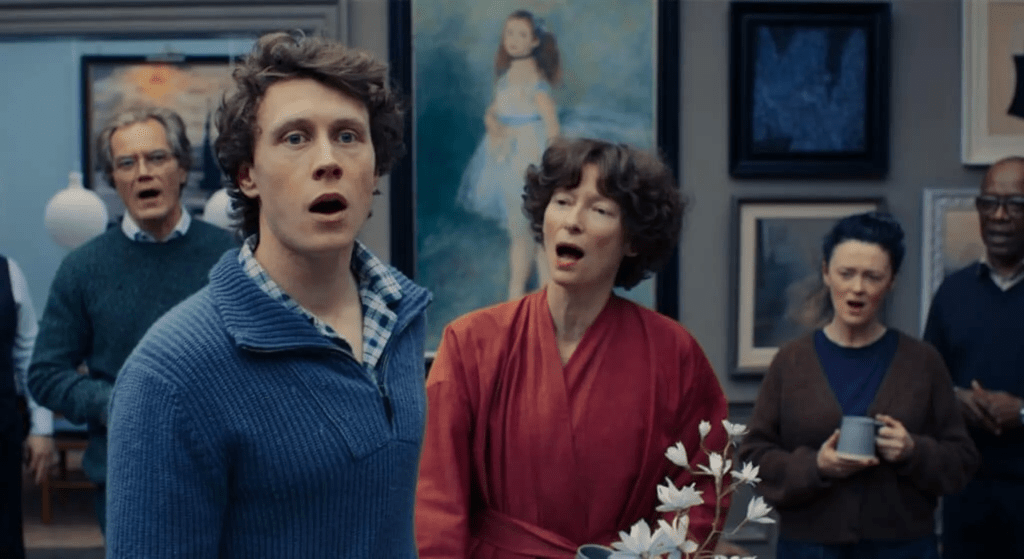
The End. Credit: Neon

Years ago – when I was clocking time at UPS before college – I was listening to an episode of Filmspotting, where they talked about director’s they’d give blank checks too. One of them was Joshua Oppenheimer, director of Indonesia genocide documentaries The Act of Killing and The Look of Silence (movies I both need to see and revisit, my younger self be cursed). They mentioned that one of the things the MacArthur Grant recipient was shopping around was a post-apocalyptic musical, a very leftfield choice and understandably one that was having difficulty getting funding. I subsequently forgot about it over the years as his documentaries placed on numerous decade lists, right up until it was announced to be showing at both Telluride and TIFF.

That musical is The End (Grade: A-), starring Tilda Swinton, Michael Shannon, and George McKay as characters known only as The Mother, The Father, and The Son. They live in an giant underground bunker nestled among salt flats with their few staff and friends; it resembles more of an art museum than it does an actual home. From the start it’s clear that in some ways, everyone is telling themselves stories to live, whether they’re aware of it or not. Father worked in the oil industry yet denies that his actions had anything to do with the disaster. The Son – only knowing the bunker – is prepped for the future but how long that future is going to last is never clear. Their routines are jarred with the arrival of Moses Ingram’s Girl, conflicting with their general pronouncements in song that the outside world is full of danger.

What happens is perhaps less important than how everyone feels about it. Oppenheimer’s script with Rasmus Heisterbeg tends towards the anticlimactic but it never feels overly concerned with plot. The Son becomes much more concerned with the “why” of things, why his parents are alone in the bunker, why they decided on their only friends, why they’re writing a history book this particular way. In the grand nature of Hollywood musicals it so often resembles, the characters break into song when their emotions become too complex for any other method. Their movements are less dancing and more the need to express, to shake out the nervous energy. Performance wise, they mostly do good; MacKay and Ingram are the two best singers, while Swinton and Shannon sound unprofessional but not unlistenable. It could’ve used some more musical numbers just to break up the pacing, despite the dialog scenes being arresting. This is the definition of a big swing, admirable in its audacity, made by someone with a deep appreciation for what movie musicals can do and fully embracing all the odd emotional rhythms that come. Of all the films here, you owe it to yourself to at least check this one out; we may never get another one.

The Room Next Door. Credit: Sony Pictures Classics

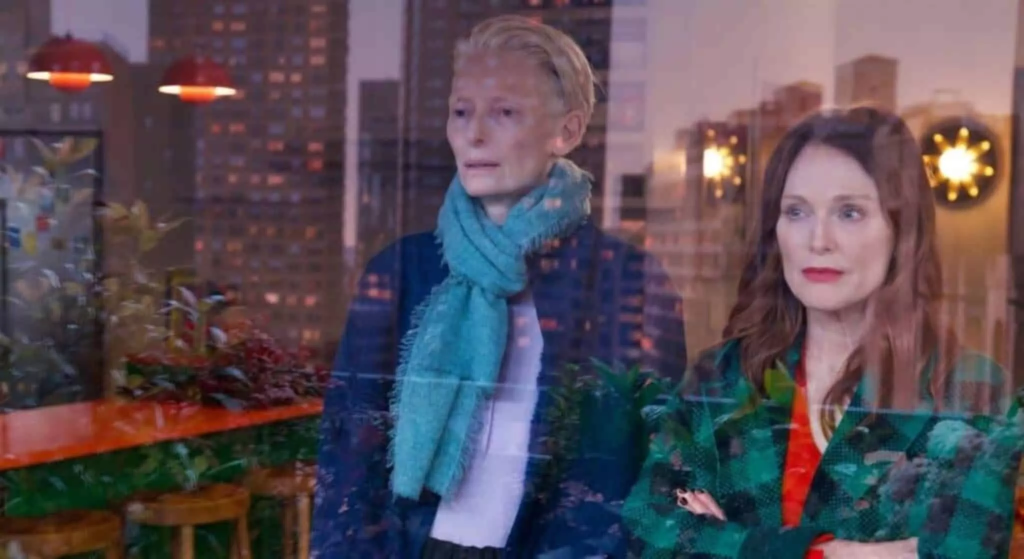
In a plesant coincidence (thanks to moving schedules around), Swinton featured prominently in the other big get of the festival, Pedro AlmodĂłvar’s Golden Lion winner The Room Next Door (Grade: B), also starring Julianne Moore. I’ve been trying to catch up on his work, having rewatched and loved All About My Mother and Talk To Her earlier this year; Pain and Glory and Parallel Mothers were two of my favorite films from the past 5 or so years, the latter possibly one of his best works (certainly one of Penelope Cruz’ finest performances).

Unfortunately, as you can tell by the rating, I have to concur with most critics in finding this to be a relative disappointment. All the ingredients for a classic Pedro are here: the enigmatic performances from two fine actresses, the beautifully colored decor, the melodramatic flourishes. But his English language debut is somehow more sedate and subdued than his past work. Swinton and Moore do fine work, as a woman dying of cancer asking her friend to accompany her on a trip so she can end her life, though strangely reserved much of the time. My audience seemed to be laughing at things that didn’t seem like they were supposed to be funny at all, even if some of that excess presents itself (like a scene with a personal trainer). Maybe it’s also that there seems to be little debate over the topic of euthanasia itself, a lack of struggle or buried emotion to burst out. His eye remains as strong as ever, as does Alberto Iglesias’ score. And yes, the rhythms of the dialog do feel slightly awkward and even repetitive at times but honestly I don’t know if it usually sounds this way to a native Spanish speaker. That Golden Lion win was the first time the major festivals have ever given him the big prize; he’s made several much better than this. Still, it’s not without its many pleasures. Maybe he can get Swinton back in Memoria mode and film her in Spanish.

Flow. Credit: Janus/Sideshow

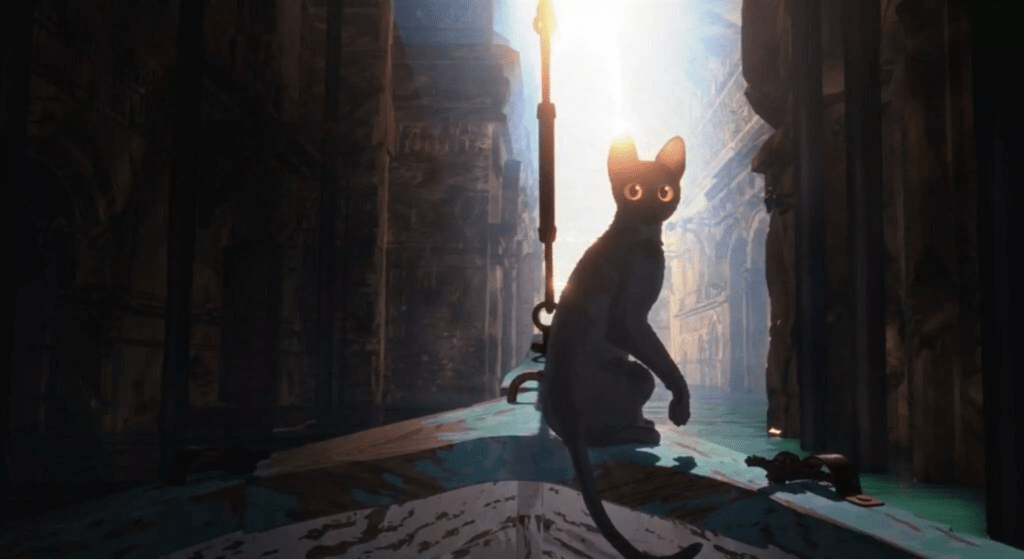
Dialog is not a problem in Flow (Grade: A), because there is none. Latvia’s pick for International Feature is an animated tale of animals traveling on a sailboat in the midst of a massive flood, communicating only via their normal sounds and body language. “Communicating” is putting it a bit strongly, because they all act like normal animals, those innate traits giving them bursts of character in response to each other’s actions, though with some leeway to – say – steer the boat. Our primacy focus is a black cat, acting as cats do as it gets knocked about by all series of torrents and creatures. Joining it are a capybara (very chill), a lemur (obsessed with a basket of shinies), an unidentified bird (injured, acting high and mighty), and a dog (pure of heart, dumb of ass). If this were made by a major animation studio, it’d be a candidate for the most annoying movie alive. Instead, it’s awash in painterly textures, content to sit in silence and calm as it observes the boat move through water. The world feels heavily inspired by games, everything from Ico to Breath of the Wild to Myst and Stray, yet it’s distinctly cinematic, the camera roving through the world and at times adopting a handheld style. What’s more impressive is that a clear narrative emerges, as do conflicts and traits, and by the end you’re rooting for them all to be friends. Can’t say I know for certain what some of the more surreal imagery might be representing, if it does at all. All I know is that I’ll be shocked if I see a better animated feature this year.

A Traveller’s Needs. Credit: Cinema Guild

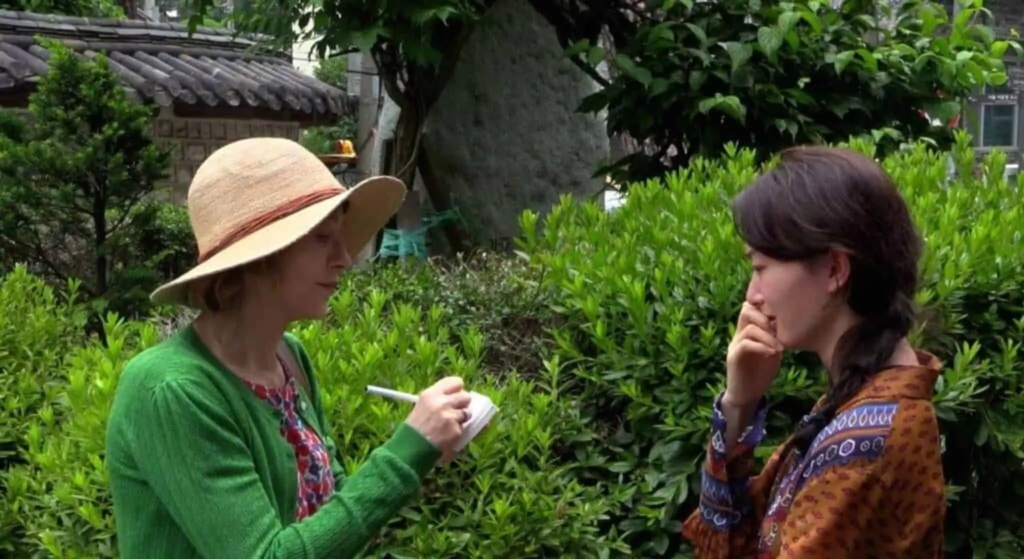
I had been planning on seeing Bound In Heaven but due to overrun from both the bumpers and introduction to The End, it started as I was getting out. My backup choice with friends was Hong Sang-Soo’s A Traveller’s Needs (Grade: C), which I probably wouldn’t have seen otherwise. I like Right Now, Wrong Then, so far the only Hong I’ve seen; it’s felt like he’s become a bit of a meme in online circles after that, with his increase in productivity and seeming decrease in actually making a regular movie. If you follow Mike D’Angelo (as I do, check out his website and Patreon), you will be familiar with a lot of his complaints about a lot of Hong’s work lately. Gotta say I agree with him.

Isabelle Huppert’s second team-up has her as a French teacher in Korea with a unique method: having people write down sentences in French that speak to their feelings and practicing those to learn the language. I doubt that’s very effective. The movie itself is mostly in English and it feels like they’re flailing to improvise or the script is so banal it hardly matters otherwise. There doesn’t seem to be much of a plot or really any character build up, just conversations about language and how playing instruments make people feel that go on too long without saying much of anything interesting. Occaisionally he does have some funny moments, like when Huppert leaves one client and they look back to see she’s already gone, commenting on how fast she walks. A later scene involving her boyfriend/roommate and his mom lends itself to some actual conflict and some interest into who she is and why she’s in Korea. It all just comes across as so arbitrary to me, down to the framing and the length of shots. I’ve known that he’s largely doing everything himself now but the image quality itself frequently looks like a home movie. I don’t want to rag on it too much because he has made at least one movie I do like and frankly, he’s made so many others in that time that I’m sure I’ll find another. As it is, it’s just kind of boring, and I’d prefer at least a little more structure and baring that, something interesting or amusing. You can make it look however you want in that case but you can’t have it both ways.

Streets of Fire. Credit: Universal

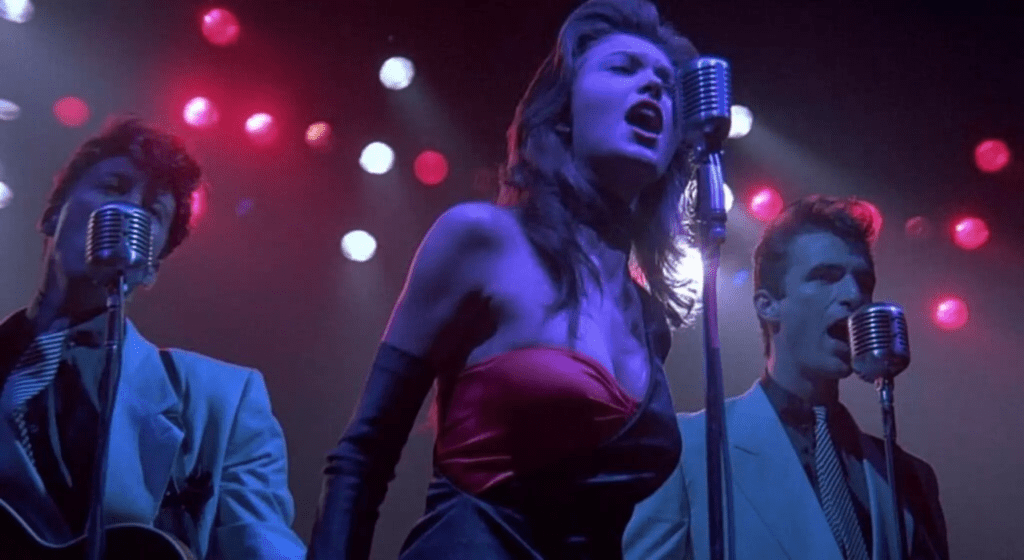
Like most other film festivals, PFF also does retrospective screenings. Usually I don’t go to them, in the past because I could find them elsewhere (and my time was limited), nowadays because chances are they’ve played it before or will play it again. I did, however, decide to go to Streets of Fire (Grade: A-) because I’d already missed it once, and my friend Evan had said I should watch it. I’m so glad I did. Walter Hill’s musical fantasia is pure cinema, exactly as the opening describes: “Another Time, Another Place”. I’ve heard the opening section of first number “Nowhere Fast” a bunch because PFS used it as the bumper for August last year, and I went a ton. The full thing still hits, and kicks off a fantastic sequence in which rock goddess Ellen Aim (Diane Lane) is kidnapped from her band The Attackers by Raven Shaddock (Willem Dafoe, extremely young & incredibly hot), leader of the biker gang The Bombers. It falls to her old flame Tom Cody (Michael ParĂ©), lesbian-coded mechanic and ex-solider McCoy (Amy Madigan), and dweeby manager Billy Fish (Rick Moranis, very surprising) to go and rescue her.

During the beginning and the end, I thought I was watching my new favorite film. Hill fuses the culture and look of the 50s with the hard edge style and talk of the 80s, creating something fully unique in the process. No other film will give you a stripper doing a vigorous Charleston to a bar full of leather-clad bikers giving straightened up Tom Of Finland while a rockabilly saxophonist wails, and frankly the fact that America let it flop is the reason we got Regan a second time. The music – from the operatic pop stylist Jim Steinmann of Bonnie Tyler, Celine Dion, and Meat Loaf – hits hard and hits quick. Once again, I could use so many more numbers. I must admit that my friend was right about the middle. By no means is it bad but it stalls a bit, and ParĂ© isn’t as up to the task of talking, no matter how cool his lines are. But when he’s blowing up bikes with a shotgun… Goddamn is he the coolest motherfucker alive.

Tomorrow: PFF33 comes to an end, with a couple last entries and my favorite 10.