Spooktober #2: Audition

A movie about lies that is itself a big lie.

One of the most iconic images in horror cinema

Spoilers for Audition, but if you’re reading this you probably already know what’s up. Additionally: Spooktober will take the form of 4 posts about horror films I really love (because a post a day was far too ambitious). Look forward to them!

Audition is a film about deception. There’s, of course, the thrust of the inciting incident of the narrative itself: a producer holding a fake audition to find the perfect wife. More infamously, there’s the structure of the film itself: at this point it’s probably more known for starting out as a serene Japanese drama before suddenly shifting into gory horror. Takashi Miike’s breakthrough film doesn’t exactly lie to the audience, and neither does the marketing. But through near total restraint and careful pacing, Miike and screenwriter Daisuke Tengan take protagonist Aoyama’s ignorance of red flags and implant it into the audience themselves. There are signs sprinkled all throughout that things are not what they appear to be. The fatal flaw is that the characters would rather live in the lie than get off the path to ruin.

Talking about Audition is naturally a little bit hard, but at this point the ending is as infamous as Psycho‘s first grand kill. It’s essentially impossible to view it in it’s pure, first time format unless – as Mike D’Angelo suggested – you hand someone an unmarked DVD containing the film and nothing else and have them watch it right there. In broad strokes, the film is about a widowed producer, Shigeharu Aoyama (Ryo Ishibashi), who – with prodding from his friend – holds a fake casting audition to find himself the perfect wife. He finds this in Asami (Eihi Shiina), who at first appears to be everything he could ask for. There’s just something “off” about her…

Having advanced knowledge actually presents quite an interesting shift in viewing – one that probably occured for all who were familiar with Miike before this film: surprise at how un-Miike like it is. Miike has of course directed over 100 films at this point, ranging from bizarre and violent to family-friendly; in the West – perhaps due to the inherent publicity from controversy over the most extreme of them – he’s famous for violence and a slightly hyper-active style. Audition, by contrast, stays almost completely rooted in a rather naturalistic and quiet mood for the first half or so. This is the key to the whole thing working, and the key to the film itself. Just after the titular audition scene, Aoyama is contacted by another worker, who reveals some mildly troubling news: he can’t seem to find any of the references Asami has left on her application. This is a rather mild slip, but Miike consciously shoots it as an omen of things to come. Time and time again, Aoyama is given an out: his friend even explicitly tells him that something about Asami unnerves him and that it would be a bad idea to continue things further.

Both Aoyama and Asami are, in some ways, lying to themselves as much as they lie to each other. Aoyama would rather believe in the non-existent perfect wife, despite the many deeply troubling signs. Asami – to a lesser extent – is willing to believe him when he says that he will love only her (it’s unclear whether she knows at this point of both his son and his dog). Seen from this angle, Aoyama’s punishment in the finale almost comes across as justified for his hubris: he’s unwilling to believe Asami is anything other than perfectly compliant and submissive, that she could ever be capable of violence until she finally turns it back on him.

Perhaps the greatest deception of all is that Audition is “torture porn”. On the one hand, it’s easy to believe given how infamous (and graphic) the finale is. Strangely enough, that finale is actually kind of bloodless if you compare it to something like Hostel, with all its guts and gore spilling across the place. It helps that Shiina underplays Asami’s psychopathy: she calmly straps herself into an apron, preparing her surgical field with deadpan efficiency. Her manner of speech is as if she’s just administering punishment, not revenge (a point for the “it’s all in his head” team). This isn’t to say there’s no blood, but rather compared to Miike’s reputation, it actually feels somewhat realistic for the actions taken. He even cuts away from the needles entering Aoyama’s eyeballs, letting us see Asami and imagine for ourselves what’s happening.

Miike has never made another film like this, though he surely has it in him from a formal perspective. What makes it so effective after all these years is the sheer nature of it as a deceptive film, tying us back to the characters themselves. We can wish all we want that it’ll end at him waking up, that someone will make different decisions, that it was all just in his head. Reality won’t let that happen, and as Aoyama does, we accept the punishment for thinking things could end any other way.

Spooktober #1: Under The Skin

Kicking off a month of horror with a modern masterpiece

On the hunt

An attempt to publish an article on a horror movie everyday this month, starting with one that may not be “pure”, but is just as unsettling.

Alien perspectives are hard to imagine. We only have ourselves as a frame of reference for what extraterrestrial life could be like, nothing except for our previous interactions with each other to go off of. Despite a limitless imagination, science fiction – when introducing sapient life – tends to default to what we believe is the proper “form” for what living beings should be. With a few small changes, aliens generally tend to behave like foreign countries interacting with each other: a base line familiarity of social interactions and biological functions. But how can we properly depict alien perspective if we can’t even escape our own?

Jonathan Glazer’s Under The Skin is perhaps the first film to truly attempt to answer this question. Its first hour is an assault of images and noise – attempt to learn human speech, English as it sounds to someone who doesn’t understand, the atonal droning and skittering of Mica Levi’s iconic score. This is not the view of someone divorced from reality or alienated (for lack of a better word) from humanity, but someone fundamentally inhuman at their core, intrigued and perturbed by what they see.

The main character has no name but is perfectly embodied by Scarlett Johansen. Her looks and demeanor are key to the whole thing working, with great subtlety in her actions and choices that may not reveal themselves on first glance. Take the various scenes in which she lures men into her void in part by taking off her clothes: she never makes any sort of pose or movement that could be defined as “sexy”. Her body language – while relaxed – remains stiff. She isn’t attempting a seduction so much as mimicking the concept; one could easily imagine her having read or been briefed on the idea, after which she goes through the motions, not because she understands what it is but because she’s been told it’s the best way to gather her prey. Most importantly is the complete lack of emotion she displays all throughout the first half (other than confusion or interest).

This is put to especially disturbing effect when she comes across a foreign swimmer attempting to save a couple who have ran into the sea to recover their dog. When he washes up after a failed attempt, she takes a rock and smashes his head with it, dragging him off to her lair while we’re left with the crying of the couple’s abandoned baby. There’s no manipulation on her part (other than the basic amount needed to convince people she’s normal); it’s best described as a crime of opportunity, the rest simply just noise to her task. We never get a direct explanation or description of what she thinks of her prey. At most we see a fascination with them, a curiosity bordering on amusement that nonetheless is unable to fully comprehend the subject at hand. Unlike most alien invasion stories, in which the assimilation is pretext for taking over the world, she is a hunter, finding game to transport. There’s no malice, no belief that her race is superior to humans (except, perhaps, in the fact that she’s harvesting them in the first place). Her behavior is fundamentally unknowable because we humans are fundamentally unable to imagine a being who doesn’t at least share a little simlarity with our way of thinking. Even as she seemingly abandons her mission – troubled by one particular attempt who chillingly describes the feeling of sinking – and begins maybe identifying with humanity, she never fully gets it. In the end, she’s still mimicking it, until by the end she’s a wild animal, unable to understand why this is happening but reacting on instinct.

It should be noted that none of this is stated within the film itself. Glazer adapted it from a Michael Farber book of the same name, which explicitly makes her an alien who’s goal is to harvest humans in a metaphor for factory farming; in doing so, he jettisoned basically any sort of identifying characteristics or clarity from the story and the characters. That actually enhances the material a lot, even though it’s no longer really an adaptation. By turning almost completely to imagery, Glazer has left the metaphor a lot more open, if you indeed choose to view the film through a symbolic or metaphorical lens. Perhaps the greatest strength of removing any sort of “depth” – as it were – is that all you have left is the experience of the main character. You’re left with a character who feels unknowable, impossible to connect to but who’s behavior still retains some sense of logic and reasoning. In reducing the story to its base elements, the humans themselves become little more than animals, hunting and preying.

Under The Skin would probably be a masterpiece just on a pure audiovisual level. There is truly, simply, nothing on earth like it, and there will never be anything else comparable. It is perhaps cinema as an aesthetic tool, first and foremost; a work that wants to submerse you within a strange new perspective and give you an experience you’ve never had before. One could pull various symbolic threads – the reverse predation of men and women, animal farming, existence itself, and on and on, and none of those would be wrong. But what sticks with me most at the end, are the images. The sound of a baby crying on a cold, stony beach, its parents washed away by the water. An inky black room, into which men are lured and sink into the abyss. Discordant strings and bare percussion highlighting your unease. It may not be a “conventional” horror film, in that it tries to be scary. But through a series of unnerving sequences, and fear of this person, it reaches a new level of unease and consciousness.

The Best Horror Series of the Last Decade Is About A Game That Doesn’t Exist

Launching a humble little blog with a humble little webseries.

Mirror Room

A repost of an entry I wrote for a Best Television of the Decade series in a Facebook group.

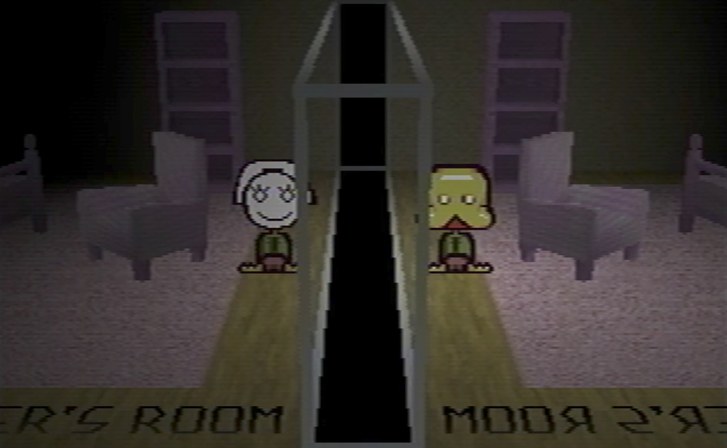
Believe it or not, 2017 had two surreal horror adjacent series that gained a deep following and acclaim from many. The first, of course, was Twin Peaks: The Return. The second was a little thing called Petscop. Although it spawned more from the annals of creepypasta and haunted video games as a lot of horror web series, Petscop distinguished itself almost immediately despite an erratic release schedule and virtually no solid information. It might be the most Lynchian thing David Lynch didn’t direct himself.

Summarizing Petscop is difficult, so we may as well start from the beginning. The first video was uploaded on March 11, 2017 (a few months before The Return would air); a month later, an account named paleskowitz posted a link to the channel in /r/Creepygaming and other than a post in 4Chan’s /x/ (Paranormal) board, this would be the most interaction the creator would have with the outside world. From the opening frame, the series commits full-heartedly to the bit, showing the PlayStation start up sequence, and the boot up of the titular game. The conceit is that the uploader found a copy of the unreleased game Petscop, and can’t seem to find any indication that it, or its developer Garalina actually existed, but there’s some freaky stuff in it. The community calls him Paul after the name he gives the profile. At first, it appears to be a fairly normal – though unfinished – pet collection game. But once Paul inputs a sequence, suddenly it shifts to a new, darker place.

The crux of the series is Paul’s exploration through this place and suffice it to say, there’s a lot of mythology. I won’t even begin to try and untangle the mess of the Newmaker Plane, the various references to adoption and child neglect, various other characters like Care. Petscop‘s refusal to explain itself lends a mysterious air, as if viewing a transmission from another plane entirely. Every question answered raises more questions, even towards the end of the series when it starts giving more solid answers. Combined with the total lack of interaction from the creator (who eventually revealed himself a few months after the last upload), it sent the community into overdrive. But somehow, it never feels frustrating. Instead, the lack of concrete answers makes everything all the more unsettling.

It’s these lack of answers combined with the style that truly makes it worthy of a Lynch comparison. While other creepypastas feed off nostalgia by using famous properties, Petscop is an entirely original thing. Additionally, it is entirely devoid of jump scares in the traditional sense; there’s barely even any blood, gore, or creepy monsters. True to the master himself, Petscop draws unease out of long periods of silence and ellipsis alternated with droning, thumping sound. Most of the series takes place in total darkness, only illuminated by the player character. It makes me think a lot of Lost Highway, in that there’s nothing really all that scary happening on screen, but it combines to make you feel uncomfortable. And although it deals in a lot of heavy themes, Petscop never gets graphic or exploitative (helped by the fact that no one in it is actually real, despite some references). Confusing as it is, there’s nonetheless a sense of logic underpinning every episode, the idea that there are rules for this world that we can’t quite grasp, familiar as they are. It’s the same sort of grounding that runs throughout the original Silent Hill trilogy, this idea that you know you’re in a waking nightmare but that it all feels normal. All of this is combined with an analog horror style (even going so far as to start with the original PlayStation bootup), largely adhering to the stylistic constraints – low quality polygons, rudimentary movements, etc – with just enough deviation that it could be what you remember those games being.

While some of the mystique may have left once the creator revealed himself, there’s no denying that Petscop is an accomplished piece of work. Time will tell if it becomes influential on other series, or if the creator goes on to new things. If nothing else, I admire a single person for creating such an accurate feeling, singular product that made me excited every time a new notification came to my phone. Something tells me this creator has a long career ahead of himself.