A movie I haven’t quite been able to get out of my mind.
The mockumentary – and, to a lesser extent, found footage – is a surprisingly underrated format when it comes to horror. Perhaps it’s due to the genre’s main association with comedies. Or perhaps the cheapness and extensibility of found footage created a default state for filmmakers. After all, why go to the trouble of drafting a world when you can just pretend someone stumbled upon this horrifying video footage (never mind the question of “who assembled this footage just so”). A true fake documentary holds greater potential, because of the nature of having to assemble something. Think Ghostwatch, where a British television special on hauntings accidentally becomes something realer. Or Lake Mungo – beloved by many, more appreciated by me – which uses a talking head format as a starting point for a ghost story.
Noroi: The Curse commits fully to its premise, presenting itself as an unreleased documentary by paranormal researcher Masafumi Kobayashi. It blends typical documentary footage and in person interviews along with archival footage of variety shows and news reports, all shot on 2005 era video cameras with the according VHS tracking from old tapes. Perhaps it’s just my love of analog horror in general, but I do think found footage and mockumentaries of this nature lose a little something when the quality is too good. Recent found footage films like Gonjiam: Haunted Asylum enhance themselves with corruption or streaming drops where the audio continues while video freezes. The goal in my mind is to look like something conceivably made outside of a studio, save for the clips used from live television. Seen today, the quality of the footage makes things look even eerier, in part because it feels “realer” in a way.
Of course, aesthetics aren’t everything. You can only do so much with low quality cameras and shaky audio before you actually need to provide a story. And this is where Koji Shirashi’s film shines. Initially, we appear to be following three different unrelated tracks: there’s a woman named Junko Ishii who’s neighbors are unnerved by her and her son. There’s Kana Yano, a girl with seemingly legitimate psychic abilities demonstrated on variety shows. Finally, there’s the actress Marika Matsumoto (the voice of Rikku in Final Fantasy X!) – playing herself – who has a terrifying encounter at a shrine.
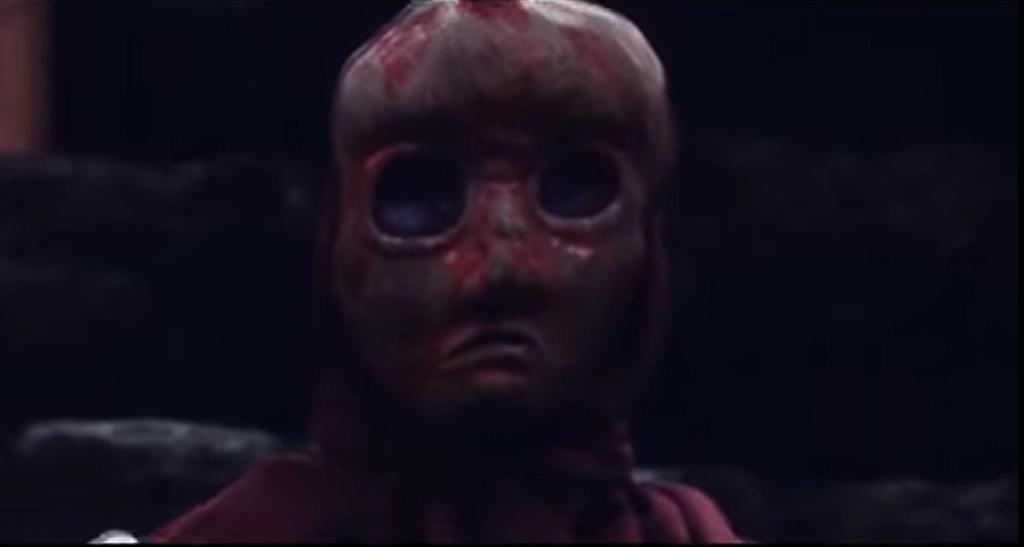
It Slowly, Shirashi and co-writer Naoyuki Yokata begin connecting the strands. There’s a man named Matsuo Hori, a psychic also suffering from some form of mental illness, who had dealings with both Kana and Marika. Strange loops make begin to appear, as do a creepy looking mask. Kobayashi begins to research a demon named Kagutaba, and the trail of death following Junko Ishii, all leading back to a village and a ritual that has gone wrong. While a little long and perhaps prone to highlighting the creepy things in the background (something that could be explained as just Kobayashi’s style), the film casts an unnerving feeling throughout. Once the stories begin intersecting, a sense of dread starts to enter, and it builds it up slowly but steadily. It’s riveting as you put the pieces together, and Shirashi’s style cultivates a genuine feeling of authenticity. There are no winks to the camera, no cheats in the concept. It builds to a finale hinted at in the beginning that explodes in horrifying power, leaving you completely unsettled. If nothing else, you’ll never see masks – or hear a baby’s cry – the same way again.
 Life of the Mind