
One of my favorite games of all time
In honor of Rez’ 20th anniversary, a repost of something I wrote about it for a Facebook group.
The world wasn’t ready for Rez.
In 2001 with CRTs maxing out at 480p, no one was getting the optimal experience, and even then it probably wouldn’t have been a smashing success coming out on the tail end of the Dreamcast era. It’s a miracle it even came stateside at all – albeit in a PS2 port and without the infamous “trance vibrator”. Rez ended up being Tetsuya Mizaguchi’s last original product for Sega before he decamped to Q Entertainment (his final would be a sequel to Space Channel 5). By all means it should’ve been a weird footnote among the many weird footnotes of that era when Sega was throwing everything at the wall, knowing the end was near. Somehow it managed to get two separate ports and an extra level in the form of Area X (which, sidenote, contains the first official work from Tetris Effect composers Hydelic. It is the platonic ideal of EDM), not to mention a spiritual successor in the form of Child of Eden, made during the Kinect Frenzy of motion gaming. In more ways than one it’s the perfect VR game; it’s certainly the one I think of first if I were to demonstrate it to someone.
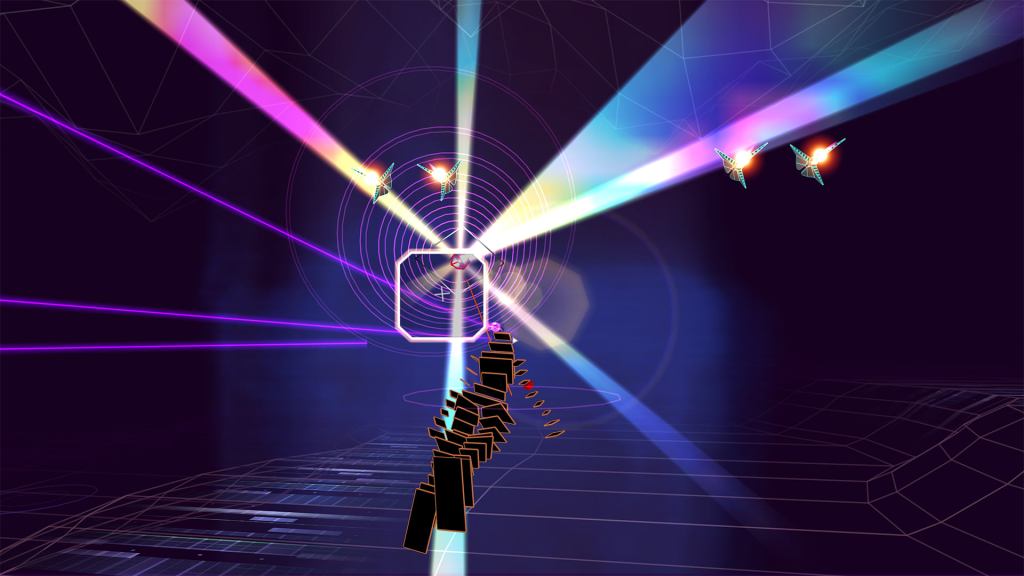
The gimmick of it all is that everything you do is tied to a sound in someway: the numbers tick up as you highlight enemies, and shots fire off bloops and tones as they make contact. Locking on to the maximum 8 causes a chorus to sound when you release. Handclaps sound if nothing is targeted. A voice counts down every time you hit the node and the music shifts into the next phase, building as if in a rave. A ship times its shots so that when they release they sound like percussive elements.
Describing Rez to the uninitiated is a bit of a struggle – which perhaps speaks to how Sega clearly didn’t know how to advertise it. Most people describe it as a rhythm game but that’s not entirely accurate. Broadly speaking, it’s a rail shooter: you control an on-screen cursor as a wireframe avatar floats through surreal landscapes, holding down X and moving the left stick to lock on to objects on-screen. Releasing X fires up to 8 shots at enemies on screen. Powerups come in the form of blue spheres that add life, and red spheres that allow you to automatically target everything on screen. Each layer level (as its called) is broken up with a Network Node in the form of a cube you must first break off of, then target with 8 shots.
Unlike a rhythm game where everything is mapped to a specific moment and missing penalizes you, every shot you make stays on beat no matter how late you are targeting or in what order. Rez’ goal is that of synesthesia, like many of Mizaguchi’s other games (Lumines, Tetris Effect). Enemies explode into bursts of color, into hieroglyphics or tigers and lions. They fly by on small bikes, the paths making lines that spiral across your vision. In the background, statues beat in time with the music as does your avatar. More than anything Rez is an ultimate expression of aesthetic art, every action you take heightening the confusion of the senses and pushing you further into a hypnotic state.
Of course, there is a story to Rez but you could be forgiven for not noticing it. The short version is that in the future, an advanced AI named Eden has a mental breakdown due to information overload, threatening the world. You play the hacker that’s sent in to try to free her, battling enemies and taking down bosses in the form of firewalls and security systems that attempt to protect her. While the overall story of world peace and metaphors of life may not pop up until the final level, the hacking motif is all over the game: enemies you target scroll down on the left side with. Getting a new form causes “File system: updated” to sound in a robotic voice. Targeting the cube is called “cracking password”, with the phrase “Security Breached” circling you. In no way is it realistic but it fits in with the charm. It’s like someone decided to make a game out of the hacking sequences in Neuromancer, something you can actually simulate in VR mode with a headset. It’s a more optimistic vision of computer hacking, a very early 2000’s view that’s only got more charming as time goes on.
The best expression of this synesthesia is in Area 1, with the track “Buggie Running Beeps” by Sega in house sound designer Keiichi Sugiyama. It builds like a rave, starting with a droning tone and moving into slow beats before it explodes into a full on party. Elsewhere, tracks like Area 4’s “Rock Is Sponge” from Joujouka nervously drill on until suddenly guitars kick in as you’re flying through an arena, chasing after a running man made out of cubes, a truly mind blowing moment. Area 5’s Fear Is The Mind Killer from Adam Freeland and Coldcut brilliantly matches the title phrase to enemies, speaking the title as you shoot them. Describing Rez in words is honestly rather useless. You have to experience it for yourself, controller vibrating in time, to really get the sensation.
 Life of the Mind