A slightly different tack for reporting on Da Movies™
Credit: Philadelphia Film Society
A lot can change in the course of a year. For instance: last year at this time I was still employed, my uncle had just died, and my plans for that year’s Film Fest were scuttled both due to a small concert planning mishap and said death. Not to mention feeling a bit disappointed at the lineup that year – most of the high profile ones had either already released (Anatomy of a Fall, Killers of the Flower Moon) or were being held back for some unknown reason (The Zone of Interest, May/December).
Cut to this year: my job dissolves in November but wow, are the movies great. Which is all to say that today marks the official start of the 33rd Philadelphia Film Festival, aka the moment when my best of list gets filled out. This year is already an embarrassment of riches with the Philadelphia premieres of Anora and The Brutalist but factor in the new Mike Leigh, Payal Kapadia, Steve McQueen, Andrea Arnold, etc etc? Well… scheduling was a bit of a nightmare to say the least. I actually had to buy a badge for the first time this year thanks to demand which means I can now attempt to try every centerpiece plus opening and closing (a small blessing in disguise) and barring a few social events or exhaustion, my plan is once again to squeeze as many movies as I can in front of my eyeballs.
To that end, the purpose of this post. I’m gonna try something I wanted to do last year but couldn’t thanks to aforementioned personal issues, wherein I’ll do a daily recap/rundown of everything I saw in the style of The Dissolve and The AV Club‘s dispatches. The plan is to put up a post the next day with small(ish) reviews, ending with the usual top 10 or so when the festival ends. I will do my absolute best to put it up in a timely fashion – say, the morning of or afternoon – but I’m only human and, because I’m doing this on my vacation time, delays may occur.
All said, I’m pretty excited for this year. Some hard cuts may have had to happen but I’m confident those will come around sooner or later. If everything is as good as the hype has been, the year end list is going to be an absolute ordeal. I can’t wait. Hope you’ll follow along!
The Anne Hathaway/Thomasin McKenzie two-hander doesn’t know who its’ title character is
Note: Expanded from Philadelphia Film Festival thoughts
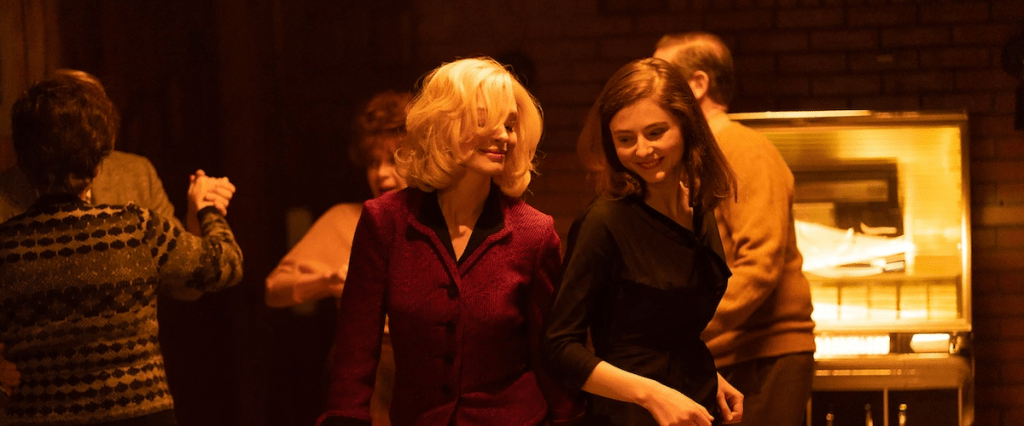
Eileen is the sort of movie that promises a lot from the get-go. In its very first scene, we see the title character (Thomasin McKenzie) observing a couple getting frisky in the car next to her, appearing to get turned on herself before she shoves snow down her pants. The 60s setting and icy New England landscapes would point to some sort of repression on her end; at the very least, with an alcoholic father and dead-end job at a juvenile corrections facility in a remote town, her life doesn’t seem to going great.
All this is before Rebecca Saint John cruises into the parking lot in a Mustang and captures her attention. As embodied by Anne Hathaway (doing an accent, and doing it pretty good), Rebecca is the New Woman: unmarried, unwilling to take men’s shit, handling a cigarette in the way mysterious yet alluring women tend to do in movies like this. She’s arriving to take over for the prison psychologist and begins to take something of an interest in Eileen. Is it a crush? Simple mentorship? Something more sinister? The scene seems set for a dark sort of seduction.
Unfortunately, Eileen herself never seems to snap into focus. McKenzie also does an accent and it’s rather passible, but her character is too passive and internalized. The script is an adaptation of Otessa Mosfegh’s book – written by the author and her husband – and it feels as though large portions of an internal monologue were lopped out rather than integrated. Periodically, there are supremely jarring moments of fantasy where Eileen imagines herself having rough sex with a prison guard or shooting herself in the head, and they always come out of nowhere. It’s hard to even figure out if Eileen has some sort of repressed sexuality or obsessive desire since it’s not always clear what exactly she wants. Which means that Rebecca’s background story involving a prisoner who killed his father starts to become a lot more interesting, despite it being an ostensible side show.
The film takes a sudden swerve in the third act heightened by an impassioned monologue from Marin Ireland that also raises a boatload of interesting things to explore. For a moment, it seems to get into some thorny territory that itself could make a great story, but the movie ends before it has a chance to fully examine that. It’s not an issue of direction – William Oldroyd keeps a tidy pace and a clean visual style that makes great use of dark – but that aforementioned missing bits. It might’ve needed to be longer to fully unpack the impact of the massive twist. As it is, Eileen presents a titilating scenario but can’t make its protagonist shine through it. (C+)
A stunner of a debut following a lesbian teacher in Thatcherite England
We like to think that we’re better than the past. It’s just the way of the world: as time goes on, we make progress. Things improve and we learn to be more tolerant. Films about minorities tend to fall under this a lot, and it’s understandable to want to show someone fighting for their rights, or there being one person who was on the right side of history, so that the viewers can walk out of the theater shaking their heads and chattering about how awful it was back then and isn’t it nice we’re not like that anymore?
What I’d like to suggest is… maybe we’re not?
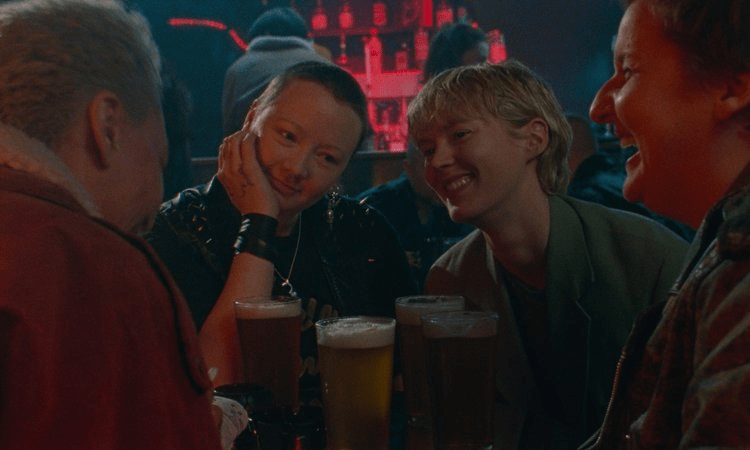
Blue Jean, the debut film from Georgia Oakley, is set during the late 80’s in the midst of Thatcher’s England. Section 28 – which banned the promotion of homosexuality within schools – has just become law. Characters will talk about this but otherwise it hangs over the movie like a cloud, a warning. The titular character of Jean Newman (Rosy McEwan) is a high school PE teacher who also coaches a girls netball team. She is also a lesbian, and at nights she transforms into the proper attire and hangs out at a gay bar with her friends and especially lover/girlfriend Viv (Kerrie Hayes), a leather butch in contrast to Jean’s more androgynous appearance (it’s a wonder she doesn’t get more rumors behind her back).
There’s some suggestion that Jean’s sexuality is a somewhat new development for her; while she doesn’t have that self-loathing that so many queer films gravitate to whenever they take place pre-1995 or so, Jean is rather happy and seemingly carefree in her carefully regimented life. Despite this, there’s a sense she’s still a little bit afraid to embrace herself, hiding Viv from her sister when she makes an impromptu visit in an early scene, and shying away from bonding with co-workers (who chitter about the law during lunch).
All of it threatens to come crashing down when she gets outcast and loner Lois (Lucy Halliday) to join the team, then subsequently sees her in the same bar where she finds such freedom. It’s here that Oakley shifts the tone to something akin to a horror film, though it never fully tips over. A terrible dilemma begins to present itself: both student and teacher know about the other. One desperately wishes that Jean could be something of a mentor to Lois, perhaps even shield her more from the bullies. But as an earlier scene makes clear – in which Jean tells Viv how she pretended to be her boss when calling a parent about one of the girls – she can never show anything that could be construed as favoritism. Not only that, but anything that could even remotely suggest she might be forming a relationship with a student beyond what’s appropriate. What the film lays bare is that laws like Section 28 create a cycle of oppression and more fear in both the adults and the youth. These moral panics about groomers discourage teens from seeking help, and adults from standing up for them and themselves. Because it’s not just her job that’s at stake for Jean, it’s everything. But what tilts it into greatness is the ease at which Oakley also expresses Lois’ point of view, depicting an understandably angry youth caught in the worst sort of rock and hard place.
Blue Jean‘s final moments bring a note of grace and understanding for both characters, while doing its best not to put too neat a bow on things. There are perhaps moments when it feels a little too blunt, too tuned into what feels like contemporary moments. At its very best, Oakley reminds us that the struggle is forever ongoing and what seems like a new low has really always been here. Those in power do their best to stamp out queer history, to make mentorship a liability and keep us at each others throats. In balancing this joy with dread, it reminds us why the fight is worth it, and who it’s all for.
The second film from Andrew Semans, available on VOD
Hall gives one of the year’s best performances.
“Trauma” – alongside “grief” – has become something of a trend lately within culture. It comes up in interviews about Marvel properties, it’s the main theme “elevated” horror movies or a new reboot of an 80s property. None of this is new of course: horror is especially fruitful for examining loss or processing something that happened to you. But there is a sense that it’s a little sanitized. The victim is strong; they build defenses and ultimately overcome it.
In Andrew Semans’ Resurrection, the trauma of Rebecca Hall’s character manifests itself in a physical reaction. Her character – Margaret, a pharmaceutical executive – is attending a conference, looking bored. She fidgets, attempts to stay awake, turns her head and catches sight of a man sitting a few rows down. Suddenly, her eyes widen and as she stumbles out of the room, she takes off at a run that turns into a sprint. We don’t yet know who this man is but immediately we can tell he’s bad news.
As the movie starts, Margaret is the quintessential image of the high-powered executive. Steely, determined, there’s an intimidating air to her but with a hint of warmth shown as she gives an intern relationship advice. She has a daughter – Abbie (an excellent Grace Kaufman) -17, and about to head off to college. Her love life consists of calling up a married co-worker for no-strings sex that always happens at her place. Hall plays her as a woman in complete control over every aspect of her life, dominant but not domineering. Naturally, this brief moment of panic sends her spiraling as the man (Tim Roth) reappears around her, always from a distance. Something bad has clearly happened to Margaret in the past, but is it going to happen again?
Resurrection follows a similar path of woman-on-the-verge films like Repulsion or Possession by staying ambiguous about Roth’s character. In a stunning 7-minute monologue in which the background slowly fades to black, Hall details a shocking history of violence, gaslighting, and abuse that sounds too insane for anyone to make up. Her performance in this moment is a tour-de-force: completely absorbing and impossible to turn away. That she’s giving this to her intern who reacts in horrified confusion is what turns the movie on a dime. Semans puts us directly into Margaret’s increasingly paranoid headspace through some savvy camera work and an unnerving score from Jim Williams as Hall’s perfect composure crumbles throughout. It’s a gripping performance, matched perfectly by Roth. He plays David as chillingly polite, almost rational; we know he’s a madman but his reserved tone almost makes us fall for his gaslighting as Margaret regresses more and more.
Perhaps the most devastating plot point – and, in my mind, the key to the film – is through Abbie. Margaret exerts more and more control over her as a means of protection, going as far as to do whiskey shots with her to keep her from leaving their apartment. Logically, she should tell her daughter who this mysterious figure from her past is and explain herself, but she can’t. Her behavior manifests as irrational and frightening, for all intents and purposes looking like a complete mental breakdown. Semans doesn’t turn either side into a villain so much as portray how this unexamined trauma can manifest cyclically; it’s heartbreaking because Abbie clearly sees her mother is suffering but in the process is making her unsafe.
For some people, this movie may not hold together. The ending takes a gigantic leap that – although set up – shifts things into an entirely new direction that clashes with the tone of realism from before. Admittedly, there are some scenes I wish were slightly different, if only to keep it on a more symbolic or psychological level. But there’s something to be said about a movie that fully commits to its premise, logic and sense be damned. Hall is the stand-out, of course: it doesn’t work if we don’t believe her, and I believed her. This is a bold feature, a tightly coiled work of anxiety and tension up to its startling climax. When the filmmaking is this good, what do a few flaws matter?
I’ve always been bizarrely fascinated with censorship codes. Maybe it’s living in America, where we don’t have that sort of legal control over media unless it’s like, abuse material (historical examples notwithstanding). Of course, it’s not like America’s own censorship board doesn’t wield a large amount of control over theatrical releasing; think about how the NC-17 – supposedly for more “adult” movies that weren’t porn – ended up becoming near exclusively associated with sexual content to the point that it basically doesn’t exist. All this is done in the name of protection, but who is it really protecting? How does one even determine the right amount of vein slashing and rape that’s acceptable for a motion picture? It’s all very technical stuff.
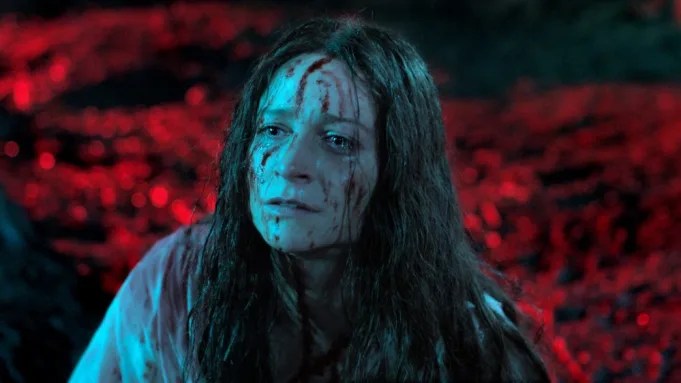
As you can imagine, Prano Bailey-Bond’s Censor was catnip for me, following – as it does – a censor for the BBFC during the 1980’s video nasty moral panic. In brief, “video nasties” were extremely violent (often sexual) exploitation films that burst in popularity when VHS became popular. The credits show that they included everything from more “classy” pictures like Abel Ferrara’s The Driller Killer to infamous faux-snuff film Cannibal Holocaust; it falls in part to Enid (Niamh Algar, in the titular role) to determine if the film is releasable, and what cuts could be made to allow it in. She takes her job extremely seriously; as she tells her parents, she’s not doing it for entertainment but to “protect people”, as much a product of Thatcherite conservatism as it is lingering guilt over the disappearance of her sister. That deeply repressed guilt starts to bubble back up after viewing a film that strongly resembles the circumstances of that disappearance, throwing her off kilter and beginning a descent into mental collapse.
Bailey-Bond’s film is first and foremost about “vibes”, specifically in capturing the specific era of 80’s Britain in the midst of a moral panic. The BBFC offices here are all drab washed out lighting betrayed by the recurring screams from the women in the films the censors watch. These films themselves are shot in a squarer aspect ration complete with VHS grain to recreate that exploitation aesthetic. Interspersed are hallucinatory sequences reflecting her own fractured state of mind, awash in neon lighting, consciously returning back to the scene of the crime. Although it’s critical of the idea that exploitation movies caused a rash of violent, Bailey-Bond and Anthony Fletcher’s script doesn’t argue that they’re totally harmless. After all, the censors themselves have to expose themselves to some truly awful scenes day in and day out, fake though they might be. Enid professes to not be affected by them, treating it purely as a job, but the film suggests she’s internalized more than she wants to admit.
It all comes to a head in a brilliant final act, in which her two worlds collide and her denial comes spilling out. All this time, Algar has become convinced – without much in the way of evidence – that her sister is actually the actress in the film, and without spoiling, it becomes a cutting statement on conservative hypocrisy and the need to convince oneself that they’re the good guy here. Censor could’ve been a touch longer – I personally would’ve loved to see more of the censorship process itself – if only for Bailey-Bond and Fletcher to expand on their ideas more. Still, this is an audacious debut, one that establishes Bailey-Bond as a filmmaker to watch and Algar as candidate for Best Actress.
I didn’t “get” Paul Thomas Anderson’s The Master the first time I saw it. Or rather, I don’t think I really possessed the skills to appreciate it. My first time was in high school, circa 2014 or so, which was right around when I was really getting into film seriously and checking out lists. I remember drafting an email to Filmspotting because I’d heard them talk enough about it, and asking what it all meant (they were kind enough to respond, so shoutout to them); it wasn’t so much that I thought it was pretentious but that it felt like an series of scenes disconnected from each other, without much meaning. Teenage me really struggled to put it together – and separating it across two nights probably didn’t help much either.
Perhaps it’s one of those movies you need to watch a second time. Perhaps going through college – and also watchingquite a lot more films – exposed me to more similar structures. Maybe I just went in with a much open mind, not high off the refrains of “masterpiece” and “Best of the decade”. It might even be that I was mistakenly primed to expect a movie about Scientology, or a two-hander featuring a villainous Philip Seymour Hoffman. Whatever the reason was doesn’t matter anymore. Because now? I get it.
The Master is – in my mind at least – best thought of as a character study of one very specific, very damaged man, Freddie Quell (Joaquin Phoenix). It’s a lot more linear than I remembered it being; while there are some flashbacks (and one moment that takes place solely in his mind), everything you see on screen appears to be pretty much exactly what’s occurring. At first, I actually thought it was about World War I and was going to slot it into the grand theory that “All Works Involving World War I Are About How Fucked Up It Was” before being reminded that no, it’s about the Second one; specifically, the immediate aftermath. One of the key scenes takes place just after we here the announcement of the surrenders on a radio: all the soldiers lining up in formation, traveling up some stairs to hear a speech from a commander. He essentially tells them that the war is over, and they’re going to be reintegrated into society. Civilians will not understand what they’ve been through; it’s possible no one ever will. Crucially, there is no offer of help for these men. These are the ones without prominent injuries, the “normal” ones. They have been through drastic reshapings of their entire personalities, turned into killers, and yet the military expects them to become normal functioning members of society despite having seen the absolute worst that humanity is capable of. Ironically, that’s not too far off from the treatment of veterans in World War I, or even the treatment of veterans today. How can anyone be expected to be normal when your entire state of being has been so altered?
For Freddie, this may have been an impossible task even if he hadn’t been on the frontlines. His first on-screen appearance sees him mimicking sex with a sandwoman, discussing how to get rid of crabs; during a psych eval, he sees every single Rorschach image as genitalia. Soon it will become apparent that he is likely not joking about that. Even if you don’t fully connect with the film as a whole, Phoenix’s performance is still a wonder to witness, with his peculiar way of talking out the side of his mouth, his jerky movements. As charming as he’s capable of being, there’s always the feeling that Freddie is just moments away from violence. This – combined with his habit of borderline poisoning himself – gets him fired from one job and chased off of another.
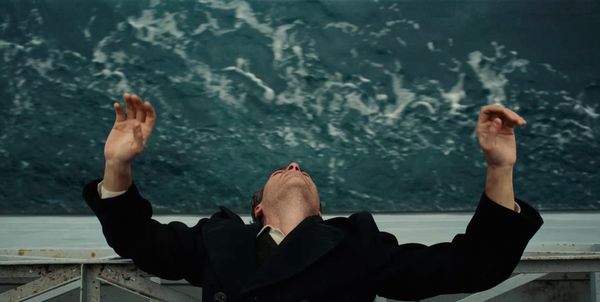
He quite literally stumbles across salvation in the form of Lancaster Dodd, who’s daughter is getting married on a boat Freddie drunkenly runs to after accidentally poisoning a farmworker. While Dodd – of course – is based off L. Ron Hubbard, I think going in with that knowledge may warp your understanding of who he is. Philip Seymour Hoffman’s performance isn’t menacing, per say, nor does it appear to be overly indebted to the father of Scientology. On some level, he’s performing, yes. But watching it again, I feel that Dodd isn’t anything less than completely genuine about his beliefs, or at least his desire to help people. Does he really believe he met Freddie in a past life, as he claims? Does it necessarily matter? Either way, Freddie’s addition to their party comes not from a desire for conversion, but rather because Dodd wants more of his noxious concoctions.
None of that means that Dodd isn’t also an extremely harmful and manipulative presence. The much praised initial Processing scene shows Freddie subjected to a series of questions that soon begin falling into disturbing and highly personal details (much like the way Scientology collects blackmail material). It’s perhaps telling that Freddie at first finds the process “fun”: at first they merely consist of odd questions like “do you linger at bus stations for pleasure” and “are you thoughtless in your thoughts”. In their article proclaiming it the best scene of the year, the AV Club describes it as “designed to break down a subject’s psyche and offer a kind of euphoric relief from his or her problems.” That part comes when Dodd starts asking him about where his parents are (dead and institutionalized), if he’s killed anyone (Japanese in War and possibly the worker), and – most shocking – if he’s had sex with any of his family members (his aunt, 3 times). At the end, Freddie’s crying, perhaps finally having gotten the burden of his sins off his chest. It’s telling that Dodd doesn’t offer him judgement on any of this; he doesn’t ever bring it up even in the climactic jail scene fight. As questionable as these methods are, does it really matter if people find a sense of healing through them?
As great as this scene is, there’s actually a later moment that I found to be the key to unlocking the film for me. The Cause is at a house in Philadelphia (owned by Laura Dern!); Freddie’s “therapy” has begun in earnest through an exercise in which he walks across the room and touches the wall, describing it, then walks to the window and repeats. Dodd makes him do this over, and over, and over. This is about when Freddie has begun to disturb other members of The Cause including Dodd’s wife Peggy, and his daughter Elizabeth through sexual overtures and violent outbursts. Doubt seems to be spreading within Freddie as well, even though he remains devoted to The Cause. The exercise stretches on as Freddie gets more and more frustrated, until the members break for lunch and he ends up slipping into describing the conditions of the frontlines with each pass from the window to the wall. In this moment, it becomes clear that The Master is pretty much all about the various traumas Freddie has been repressing to his overall detriment. It’s the start of when Peggy begins to seed the idea that Freddie is beyond the help of The Cause, maybe even beyond help in general.
That’s the most fascinating idea in the whole film, the thing that keeps it from being a straight up Scientology take down. Lancaster’s efforts are genuine – even if he claims that they can cure leukemia, among other things. He can see that Freddie is in turmoil. But even a sketchy pseudo-religious movement has to recognize when to cut their losses. In the rapidly changing society of post-war America, people are fumbling around for any sort of authority, any meaning out of the violence that’s been done to them. But how do you move on from this trauma when violence and dysfunction is the only thing you’ve ever known?
The world has changed a lot since 2014. I’ve changed a ton. I wasn’t fully aware of how much the military is about forcing someone to change their entire socialization. I hadn’t yet learned about how traumatized WWI left everyone. Perhaps most relevant, I hadn’t experienced films that were content to let you puzzle out their meaning, extract symbols from shots, let the explicit be implicit. The Master, more than anything, asks a lot out of you simply by following it’s own rhythms, its own psyche of sorts. It’s a mood that can feel impenetrable at first, but reveals a wealth of substance once you open up. I have a feeling I’ll be revisiting There Will Be Blood soon. Having acknowledged they’re both character studies rather than battles – and without the latent contrarianism – feels freeing, like a new period of growth. I can’t wait to experience it.



 Life of the Mind