

Last of the high profiles.
Finally managed to do a 5-movie day and it wasn’t too bad! Could feel the strain by the end so if you’re wondering what the maximum amount someone can watch in a day, it’s probably that. All that’s left is closing night and whatever stragglers I picked up along the way.
Once Upon A Time In Harlem (William Greaves, David Greaves): A-
I do wonder what my reaction would have been like had I not gone into this knowing that it uses ElevenLabs to reconstruct some of William Greaves’ voice when he reads out certain passages. As an archive it’s invaluable seeing a lot of new-to-me writers, artists, and intellectuals all gathered together, keeping each other’s memories alive. Greaves’ trademark splitscreens and overlapping voices help move things along and I would love to see the full 4 hours of footage sometime. Most compelling are the arguments and discussions, people butting in to make sure someone like Zorah Neale Hurston gets her flowers or whether the Harlem Renaissance is still alive. It’s as much a marker for how far they’d come as it is a specific moment in time between several famous periods, and how you never realize you’re living through history until after the fact. Whether that’s ruined by what’s essentially the use of audio colorization is a question I am honestly not sure I can fully answer.
Extra Geography (Molly Manners): B
Cute coming-of-age at a girl’s boarding school distinguished mostly by the Yorkshire accents and the burgeoning lesbianism that neither quite seems to realize is there. Funnily enough it’s also about Shakespeare, and I may have been tickled by the way Flic (played by the extraordinarily named Galaxie Clear) dismisses A Midsummers Nights Dream as much as I was by how in-sync she is with Minna (Marni Duggan). Shares my issue with other ostensible two-handers in that the points-of-view are imbalanced – in this case towards Flic – that feels like it might’ve been a holdover from the short story it’s based on. Ditto the nonspecific time period, in this case looking like at least the 90s or early 2000s though on the other hand it avoids pandering with needledrops and other signifiers; unless you count ending with “The Book of Love” from The Magnetic Fields, and there’s worse ways to end a movie. Overall well-shot and often funny, with a pair of performances that bodes well for the future.
Everytime (Sandra Wollner): A
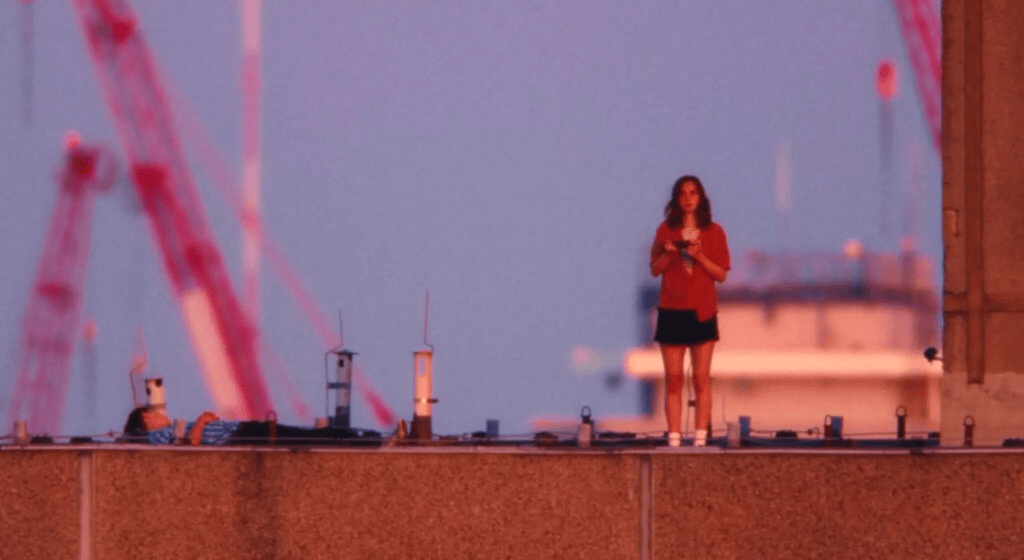
One of those films that ends up hitting me in ways I find difficult to fully articulate. If broken down by the Hawks line of “3 good scenes and no bad ones” I’d submit the following: rooftop, discovery in the hall, and The Great Departure. Expected something in the line of MMOs or gaming to feature heavily, didn’t realize it’d be Minecraft but somehow that works in a way that’s completely surprising when you discover what the poster is based on. Aftersun comparisons also wouldn’t be wrong but it’s more focused on explicit grief mixed with technology’s impact (there’s a Personal Shopper-eque texting moment that gains real power) and a more dreamy atmosphere that could verge into metaphor or reality or both at the same time. Wollner’s control is simply incredible, there’s nary a single shot that isn’t stunning, almost peaking early with a shockingly casual inciting incident. In the end it’s a strange sort of grace, suggested at by voiceover but written poetically, a hopeful vision of the afterlife and the persistence of our memories. (In the interest of disclosure it appears that Suno was used for a small moment of generating music in a TV ad but I honestly didn’t notice and don’t know if that was made directly for the movie or not. Is it bad? Kind of! I don’t really know what to do with that but it’s there, and the score is otherwise a wonderful mix of bleeps and bloops).
Minotaur (Andrey Zvyagintsev): A-
The personal becomes political and the political will encroach on your life whether you ignore it or not. Hadn’t seen Unfaithful or the Chabrol it’s based on so I don’t know if this follows it completely but Zvyagintsev adds a jolt with corruption and moral degradation. Dmitriy Mazurov displays a sort of desperate grapple to remain in control of his life, trying to appear as if he still has the moral high ground while his soul slips right out of his grasp before he’s even aware it’s in danger. Less a protest against the Russia-Ukraine War – though it most definitely is – than showcasing the rot within the country that leads to a downfall as much as a series of cascading, yearslong decisions leads to the collapse of a marriage. Arresting on nearly every level – especially with the beautiful glass buildings and reflections, a near perfect melding of its core themes together. Maybe could’ve ended somewhat earlier though the image it lands on is discomforting in its own unique way. One of these days I’ll get around to his other work.
Victorian Psycho (Zachary Wigon): C+/B-
Have to give it credit for not trying to make this into some sort of Girlboss Anthem and instead putting Maika Monroe all the way at 11 from the jump. Wigon verges into camp to the point that it’s not really “scary” if it was ever trying to be despite a couple tense moments; the comedy is pretty broad and ably landed by the rest of the cast enough to offset the obviousness of the satire. At times it gets a little too stylized, what with the all the shots centering something in motion as it lands on a head or the look inside Monroe’s throat. It’s fun though, and that’s kind of all that matters in something like this. Wish it had done more with Drusilla rather than focusing on her brother, and the final massacre it builds up to is all chopped up in a way that diminishes the impact somewhat though we still get some very fanciful kills. As far as crazy goes, I’d much rather something that feels deliberately weird and borderline offputting rather than something that goes door to door trying to shock you, if you get my meaning. Nothing else, a nice break from Monroe doing scream queens and getting to be the monster for once.

