Spooktober #1: Under The Skin

Kicking off a month of horror with a modern masterpiece

On the hunt

An attempt to publish an article on a horror movie everyday this month, starting with one that may not be “pure”, but is just as unsettling.

Alien perspectives are hard to imagine. We only have ourselves as a frame of reference for what extraterrestrial life could be like, nothing except for our previous interactions with each other to go off of. Despite a limitless imagination, science fiction – when introducing sapient life – tends to default to what we believe is the proper “form” for what living beings should be. With a few small changes, aliens generally tend to behave like foreign countries interacting with each other: a base line familiarity of social interactions and biological functions. But how can we properly depict alien perspective if we can’t even escape our own?

Jonathan Glazer’s Under The Skin is perhaps the first film to truly attempt to answer this question. Its first hour is an assault of images and noise – attempt to learn human speech, English as it sounds to someone who doesn’t understand, the atonal droning and skittering of Mica Levi’s iconic score. This is not the view of someone divorced from reality or alienated (for lack of a better word) from humanity, but someone fundamentally inhuman at their core, intrigued and perturbed by what they see.

The main character has no name but is perfectly embodied by Scarlett Johansen. Her looks and demeanor are key to the whole thing working, with great subtlety in her actions and choices that may not reveal themselves on first glance. Take the various scenes in which she lures men into her void in part by taking off her clothes: she never makes any sort of pose or movement that could be defined as “sexy”. Her body language – while relaxed – remains stiff. She isn’t attempting a seduction so much as mimicking the concept; one could easily imagine her having read or been briefed on the idea, after which she goes through the motions, not because she understands what it is but because she’s been told it’s the best way to gather her prey. Most importantly is the complete lack of emotion she displays all throughout the first half (other than confusion or interest).

This is put to especially disturbing effect when she comes across a foreign swimmer attempting to save a couple who have ran into the sea to recover their dog. When he washes up after a failed attempt, she takes a rock and smashes his head with it, dragging him off to her lair while we’re left with the crying of the couple’s abandoned baby. There’s no manipulation on her part (other than the basic amount needed to convince people she’s normal); it’s best described as a crime of opportunity, the rest simply just noise to her task. We never get a direct explanation or description of what she thinks of her prey. At most we see a fascination with them, a curiosity bordering on amusement that nonetheless is unable to fully comprehend the subject at hand. Unlike most alien invasion stories, in which the assimilation is pretext for taking over the world, she is a hunter, finding game to transport. There’s no malice, no belief that her race is superior to humans (except, perhaps, in the fact that she’s harvesting them in the first place). Her behavior is fundamentally unknowable because we humans are fundamentally unable to imagine a being who doesn’t at least share a little simlarity with our way of thinking. Even as she seemingly abandons her mission – troubled by one particular attempt who chillingly describes the feeling of sinking – and begins maybe identifying with humanity, she never fully gets it. In the end, she’s still mimicking it, until by the end she’s a wild animal, unable to understand why this is happening but reacting on instinct.

It should be noted that none of this is stated within the film itself. Glazer adapted it from a Michael Farber book of the same name, which explicitly makes her an alien who’s goal is to harvest humans in a metaphor for factory farming; in doing so, he jettisoned basically any sort of identifying characteristics or clarity from the story and the characters. That actually enhances the material a lot, even though it’s no longer really an adaptation. By turning almost completely to imagery, Glazer has left the metaphor a lot more open, if you indeed choose to view the film through a symbolic or metaphorical lens. Perhaps the greatest strength of removing any sort of “depth” – as it were – is that all you have left is the experience of the main character. You’re left with a character who feels unknowable, impossible to connect to but who’s behavior still retains some sense of logic and reasoning. In reducing the story to its base elements, the humans themselves become little more than animals, hunting and preying.

Under The Skin would probably be a masterpiece just on a pure audiovisual level. There is truly, simply, nothing on earth like it, and there will never be anything else comparable. It is perhaps cinema as an aesthetic tool, first and foremost; a work that wants to submerse you within a strange new perspective and give you an experience you’ve never had before. One could pull various symbolic threads – the reverse predation of men and women, animal farming, existence itself, and on and on, and none of those would be wrong. But what sticks with me most at the end, are the images. The sound of a baby crying on a cold, stony beach, its parents washed away by the water. An inky black room, into which men are lured and sink into the abyss. Discordant strings and bare percussion highlighting your unease. It may not be a “conventional” horror film, in that it tries to be scary. But through a series of unnerving sequences, and fear of this person, it reaches a new level of unease and consciousness.
A Mea Culpa for The Master

The Master
Surrender to it

When you’re too young to comprehend a film.

I didn’t “get” Paul Thomas Anderson’s The Master the first time I saw it. Or rather, I don’t think I really possessed the skills to appreciate it. My first time was in high school, circa 2014 or so, which was right around when I was really getting into film seriously and checking out lists. I remember drafting an email to Filmspotting because I’d heard them talk enough about it, and asking what it all meant (they were kind enough to respond, so shoutout to them); it wasn’t so much that I thought it was pretentious but that it felt like an series of scenes disconnected from each other, without much meaning. Teenage me really struggled to put it together – and separating it across two nights probably didn’t help much either.

Perhaps it’s one of those movies you need to watch a second time. Perhaps going through college – and also watching quite a lot more films – exposed me to more similar structures. Maybe I just went in with a much open mind, not high off the refrains of “masterpiece” and “Best of the decade”. It might even be that I was mistakenly primed to expect a movie about Scientology, or a two-hander featuring a villainous Philip Seymour Hoffman. Whatever the reason was doesn’t matter anymore. Because now? I get it.

The Master is – in my mind at least – best thought of as a character study of one very specific, very damaged man, Freddie Quell (Joaquin Phoenix). It’s a lot more linear than I remembered it being; while there are some flashbacks (and one moment that takes place solely in his mind), everything you see on screen appears to be pretty much exactly what’s occurring. At first, I actually thought it was about World War I and was going to slot it into the grand theory that “All Works Involving World War I Are About How Fucked Up It Was” before being reminded that no, it’s about the Second one; specifically, the immediate aftermath. One of the key scenes takes place just after we here the announcement of the surrenders on a radio: all the soldiers lining up in formation, traveling up some stairs to hear a speech from a commander. He essentially tells them that the war is over, and they’re going to be reintegrated into society. Civilians will not understand what they’ve been through; it’s possible no one ever will. Crucially, there is no offer of help for these men. These are the ones without prominent injuries, the “normal” ones. They have been through drastic reshapings of their entire personalities, turned into killers, and yet the military expects them to become normal functioning members of society despite having seen the absolute worst that humanity is capable of. Ironically, that’s not too far off from the treatment of veterans in World War I, or even the treatment of veterans today. How can anyone be expected to be normal when your entire state of being has been so altered?

For Freddie, this may have been an impossible task even if he hadn’t been on the frontlines. His first on-screen appearance sees him mimicking sex with a sandwoman, discussing how to get rid of crabs; during a psych eval, he sees every single Rorschach image as genitalia. Soon it will become apparent that he is likely not joking about that. Even if you don’t fully connect with the film as a whole, Phoenix’s performance is still a wonder to witness, with his peculiar way of talking out the side of his mouth, his jerky movements. As charming as he’s capable of being, there’s always the feeling that Freddie is just moments away from violence. This – combined with his habit of borderline poisoning himself – gets him fired from one job and chased off of another.

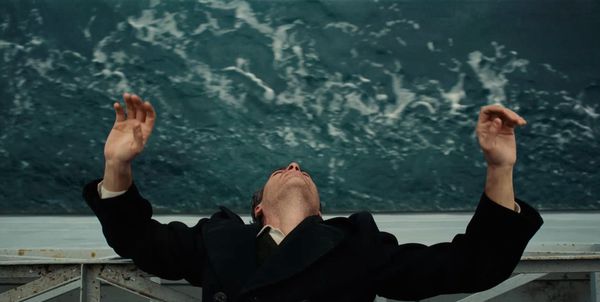
He quite literally stumbles across salvation in the form of Lancaster Dodd, who’s daughter is getting married on a boat Freddie drunkenly runs to after accidentally poisoning a farmworker. While Dodd – of course – is based off L. Ron Hubbard, I think going in with that knowledge may warp your understanding of who he is. Philip Seymour Hoffman’s performance isn’t menacing, per say, nor does it appear to be overly indebted to the father of Scientology. On some level, he’s performing, yes. But watching it again, I feel that Dodd isn’t anything less than completely genuine about his beliefs, or at least his desire to help people. Does he really believe he met Freddie in a past life, as he claims? Does it necessarily matter? Either way, Freddie’s addition to their party comes not from a desire for conversion, but rather because Dodd wants more of his noxious concoctions.

None of that means that Dodd isn’t also an extremely harmful and manipulative presence. The much praised initial Processing scene shows Freddie subjected to a series of questions that soon begin falling into disturbing and highly personal details (much like the way Scientology collects blackmail material). It’s perhaps telling that Freddie at first finds the process “fun”: at first they merely consist of odd questions like “do you linger at bus stations for pleasure” and “are you thoughtless in your thoughts”. In their article proclaiming it the best scene of the year, the AV Club describes it as “designed to break down a subject’s psyche and offer a kind of euphoric relief from his or her problems.” That part comes when Dodd starts asking him about where his parents are (dead and institutionalized), if he’s killed anyone (Japanese in War and possibly the worker), and – most shocking – if he’s had sex with any of his family members (his aunt, 3 times). At the end, Freddie’s crying, perhaps finally having gotten the burden of his sins off his chest. It’s telling that Dodd doesn’t offer him judgement on any of this; he doesn’t ever bring it up even in the climactic jail scene fight. As questionable as these methods are, does it really matter if people find a sense of healing through them?

As great as this scene is, there’s actually a later moment that I found to be the key to unlocking the film for me. The Cause is at a house in Philadelphia (owned by Laura Dern!); Freddie’s “therapy” has begun in earnest through an exercise in which he walks across the room and touches the wall, describing it, then walks to the window and repeats. Dodd makes him do this over, and over, and over. This is about when Freddie has begun to disturb other members of The Cause including Dodd’s wife Peggy, and his daughter Elizabeth through sexual overtures and violent outbursts. Doubt seems to be spreading within Freddie as well, even though he remains devoted to The Cause. The exercise stretches on as Freddie gets more and more frustrated, until the members break for lunch and he ends up slipping into describing the conditions of the frontlines with each pass from the window to the wall. In this moment, it becomes clear that The Master is pretty much all about the various traumas Freddie has been repressing to his overall detriment. It’s the start of when Peggy begins to seed the idea that Freddie is beyond the help of The Cause, maybe even beyond help in general.

That’s the most fascinating idea in the whole film, the thing that keeps it from being a straight up Scientology take down. Lancaster’s efforts are genuine – even if he claims that they can cure leukemia, among other things. He can see that Freddie is in turmoil. But even a sketchy pseudo-religious movement has to recognize when to cut their losses. In the rapidly changing society of post-war America, people are fumbling around for any sort of authority, any meaning out of the violence that’s been done to them. But how do you move on from this trauma when violence and dysfunction is the only thing you’ve ever known?

The world has changed a lot since 2014. I’ve changed a ton. I wasn’t fully aware of how much the military is about forcing someone to change their entire socialization. I hadn’t yet learned about how traumatized WWI left everyone. Perhaps most relevant, I hadn’t experienced films that were content to let you puzzle out their meaning, extract symbols from shots, let the explicit be implicit. The Master, more than anything, asks a lot out of you simply by following it’s own rhythms, its own psyche of sorts. It’s a mood that can feel impenetrable at first, but reveals a wealth of substance once you open up. I have a feeling I’ll be revisiting There Will Be Blood soon. Having acknowledged they’re both character studies rather than battles – and without the latent contrarianism – feels freeing, like a new period of growth. I can’t wait to experience it.

Deltarune: Chapter 2 Review

This might be your daddy’s Undertale

Let’s Heal Together!!

Just when I thought I was out, he pulls me right back in. To be honest I’d kind of forgotten about Deltarune. Well… not forgotten exactly, but it wasn’t anywhere near the top of my brainspace (which is completely occupied by Final Fantasy XIV nowadays). So thanks a lot Toby, because now I’m right back to wanting every episode injected into my veins. If Chapter 1 was cautiously feeling out a new space and warning people expecting Undertale 2, Chapter 2 settles into its new environment by embracing the things we’ve come to expect from Undertale: namely branching paths, insanely deep content, and instantly memorable characters. Fox’s ambition has grown, and with it so has his team.

Simply put, it’s a blast all around.

Where could she be

The number one reason is thanks to The Queen, this chapter’s main antagonist after the previous King (who honestly, I remember almost nothing about). She currently reigns over Cyber World – aka, the Library’s computer lab in the “real world” – and wants to take over the rest of it because it would be fun. I don’t know how he did it but every single line of hers is funny, just pure dlight every time she shows up. Chapter 1 wasn’t lacking for humor, but 2 feels like Fox and co have gotten fully comfortable in this new universe enough to lock on to that particular style of irreverence unique to Undertale. It doesn’t feel like a course correction from the former’s more dour and mundane tone; rather, like the rest of this chapter it’s an expansion of scope and returning to the things that made him so beloved.

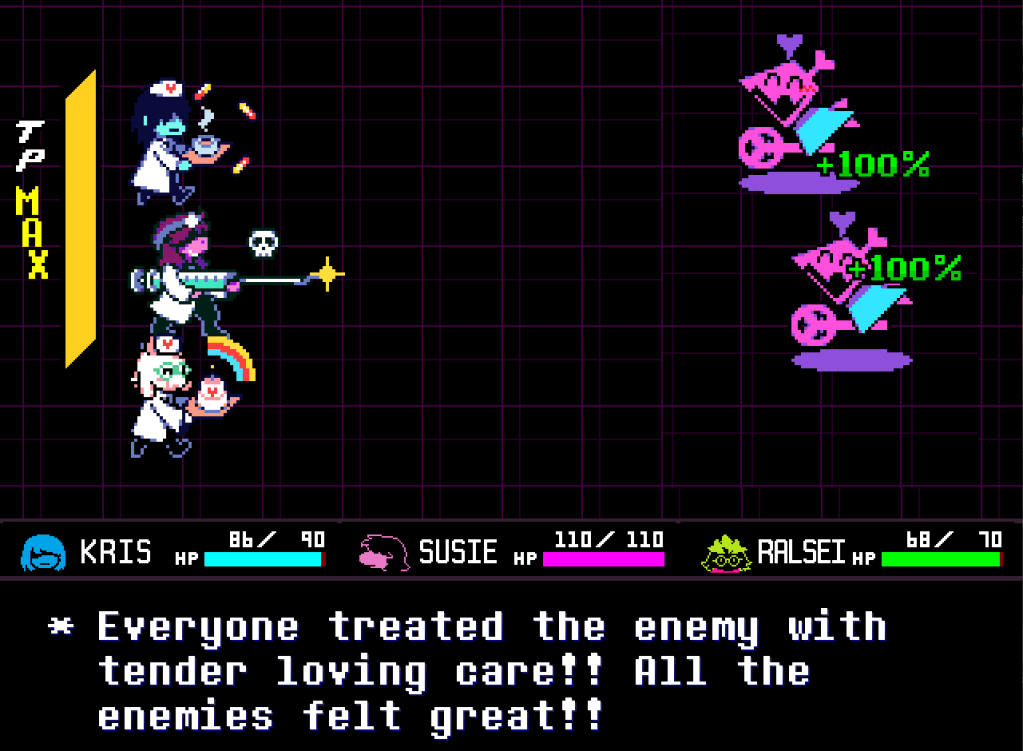
Which brings us to the gameplay. I’ll be honest, it knocked me flat on my ass several times, just like Undertale did. So far Deltarune shares a similar problem in that there’s no real way to upgrade your stats for a pacifist run. Certain gear will give you little boosts like enhanced Graze time – and Graze itself provides a new dimension to the bullet hell segments that gives it a little bit of Bayonetta‘s Witch Time, in that putting yourself in danger is a genuine strategy. But when it gets hard, it gets hard, and not even towards the end. That being said, it’s fun as hell. The addition of 2 other party members expands ACTs, changing them from something you spam to strategic attacks all their own. Now you can balance everyone ACTing with having one act, maybe one heal, and then one spare to make things go faster. It’s a fantastic system, and within it are a bunch of different minigames; the whole thing has gotten a little more interactive, like parts where you have to avoid music bars hitting you as you traverse the world.

I’ve only played through it once, and I’m fairly certain I missed a lot of stuff, at least judging from online comments. From what I can tell, there’s an entire genocide route called Snowgrave where you don’t directly cause mass murder, instead forcing another party member to do it. Fox seems to be continuning on the theme of choice, or rather your lack of it. As of this posting, it hasn’t been datamined yet, so who knows what secrets are hiding. The game seems to be going in a much darker direction than Undertale, what with Kris losing control and whatnot, or even Spamton (who, it should go without saying, has an absolute banger of a theme song). Who even knows if your romance choices will play out and be respected? There’s also the fact that you’re collecting enemies like Pokemon, possibly for an army (another reason to keep you playing the battles). I truly have no idea how long Deltarune is going to take. But honestly, I’m excited to see the rest of where this crazy journey goes. I still can’t even fully wrap my head around the implications of theories, something which could be a detriment if more esoteric and hidden stuff starts becoming important. In any case, even if the completed product goes the way of Kentucky Route Zero and takes a decade, I feel like it could be something monumental. At the very least it’ll be funny.

Some Thoughts on YorHa: Dark Apocalypse

Perhaps Final Fantasy XIV raids should stick with Final Fantasy

Examining a Pod

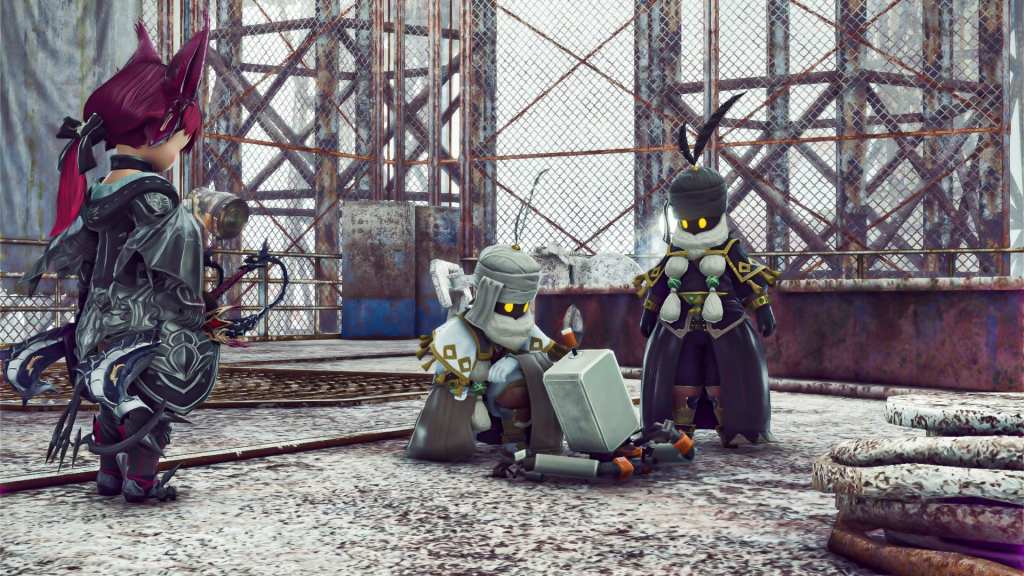
I have a feeling Yoko Taro never particularly wanted to do the Nier crossover. I’m sure, going back through his statements, you could find some typically blunt thing saying that it was a cash grab or Square Enix told him to, yadda yadda yadda. And at the beginning of the raid series (which i came to late), that probably just sounded like Yoko being Yoko. After all, he was the director of Nier: Automata! This would be incredible.

Curiously, there seems to be some grumblings within the Final Fantasy XIV community over the raids as the final patch released and the story winds down. Namely, there’s the fact that the story doesn’t really have much of an ending, instead locking off the rest of it in a weekly quest series that gives you more logs which explain things. To be fair, much of Yoko Taro’s work has been somewhat ambiguous, or at least willing to seem disappointing at first glance (as some on Reddit have argued). And of course, the second and third parts of the raid were developed smack in the middle of COVID, which affected development all around and lead to a severe curtailing of priorities and content.

All that being said – the story is definitely one of the weaker elements of the raid overall, if perhaps not the biggest reason it’s fallen in esteem. For refreshment, the main plot follows twin dwarves Anogg and Konogg as they investigate the strange bunker near Komra, leading to all your favorite Nier: Automata characters showing up. It’s hard not to notice how much of it feels like a rehash of that game, down to Anogg losing his mind when his sister appears to be dead. Of course, there’s also the cheeky connection to Devola and Popola, the twins from that game and its prequel who end up sacrificing their lives at the end of Automata. In fact, much like the other raids FFXIV has done, there’s a ton of throwbacks all over the place to Automata, the better to directly advertise a Square Enix property. The problem is that they feel more like copy-pasted amalgamations of things people already played in those games, a bit haphazardly strung together.

It doesn’t help that the conclusion has been shunted off to weekly quests that involve fetch quests around the environments, rather than doing the raids like previous ones. Now, full disclosure, I have not completed these quests, nor have I read all the info provided in the collection. It all just seems like way too much at the time, and a stop gap to learning the conclusion. I’m sure they’ll provide some form of closure if I ever get to it. But all the other raids have concluded their stories once the quest cycle is over. Perhaps players expected the same here.

The final complaint I’ve noticed the most is how disconnected it feels overall, especially the way previous crossovers have been handled. There’s the recently begun FFXV one, for example, which basically consists of Noctis finding out how to get out of Eorzea. More appropriate is the Monster Hunter: World event, which gave us two duties in the form of The Great Hunt and its Extreme counterpart. Similarly, that was presented as something of a side show: not a trial required for the main story, but also not part of The Four Lords series either. It’s entirely self-contained, which, to be fair, the other alliance raids outside of The Crystal Tower have been. However, although they may not directly affect the story, they do still expand the lore of the world or tie back into Final Fantasy‘s history in some way or another. They also integrate themselves into Eorzea somewhat seamlessly, or at least try not to appear to inconspicuous.

YorHa doesn’t really do that. Instead, it really feels as if another game has invaded FFXIV, with a story that doesn’t do a great job of explaining who all these people are, why we should care, or what the impact on the world could be. I have no idea if Square Enix is gonna try this again for another alliance raid, and honestly I wouldn’t be opposed. I guess it’s really more a mismatch between creator and product, something that’s probably not gonna be thought of as highly in comparison to the old ones.

The Best Horror Series of the Last Decade Is About A Game That Doesn’t Exist

Launching a humble little blog with a humble little webseries.

Mirror Room

A repost of an entry I wrote for a Best Television of the Decade series in a Facebook group.

Believe it or not, 2017 had two surreal horror adjacent series that gained a deep following and acclaim from many. The first, of course, was Twin Peaks: The Return. The second was a little thing called Petscop. Although it spawned more from the annals of creepypasta and haunted video games as a lot of horror web series, Petscop distinguished itself almost immediately despite an erratic release schedule and virtually no solid information. It might be the most Lynchian thing David Lynch didn’t direct himself.

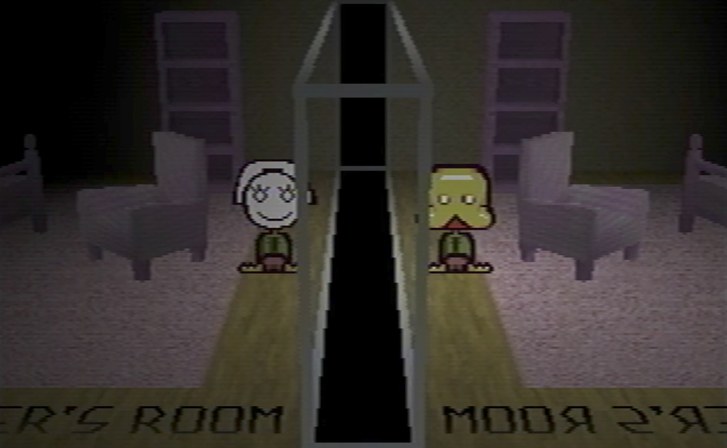
Summarizing Petscop is difficult, so we may as well start from the beginning. The first video was uploaded on March 11, 2017 (a few months before The Return would air); a month later, an account named paleskowitz posted a link to the channel in /r/Creepygaming and other than a post in 4Chan’s /x/ (Paranormal) board, this would be the most interaction the creator would have with the outside world. From the opening frame, the series commits full-heartedly to the bit, showing the PlayStation start up sequence, and the boot up of the titular game. The conceit is that the uploader found a copy of the unreleased game Petscop, and can’t seem to find any indication that it, or its developer Garalina actually existed, but there’s some freaky stuff in it. The community calls him Paul after the name he gives the profile. At first, it appears to be a fairly normal – though unfinished – pet collection game. But once Paul inputs a sequence, suddenly it shifts to a new, darker place.

The crux of the series is Paul’s exploration through this place and suffice it to say, there’s a lot of mythology. I won’t even begin to try and untangle the mess of the Newmaker Plane, the various references to adoption and child neglect, various other characters like Care. Petscop‘s refusal to explain itself lends a mysterious air, as if viewing a transmission from another plane entirely. Every question answered raises more questions, even towards the end of the series when it starts giving more solid answers. Combined with the total lack of interaction from the creator (who eventually revealed himself a few months after the last upload), it sent the community into overdrive. But somehow, it never feels frustrating. Instead, the lack of concrete answers makes everything all the more unsettling.

It’s these lack of answers combined with the style that truly makes it worthy of a Lynch comparison. While other creepypastas feed off nostalgia by using famous properties, Petscop is an entirely original thing. Additionally, it is entirely devoid of jump scares in the traditional sense; there’s barely even any blood, gore, or creepy monsters. True to the master himself, Petscop draws unease out of long periods of silence and ellipsis alternated with droning, thumping sound. Most of the series takes place in total darkness, only illuminated by the player character. It makes me think a lot of Lost Highway, in that there’s nothing really all that scary happening on screen, but it combines to make you feel uncomfortable. And although it deals in a lot of heavy themes, Petscop never gets graphic or exploitative (helped by the fact that no one in it is actually real, despite some references). Confusing as it is, there’s nonetheless a sense of logic underpinning every episode, the idea that there are rules for this world that we can’t quite grasp, familiar as they are. It’s the same sort of grounding that runs throughout the original Silent Hill trilogy, this idea that you know you’re in a waking nightmare but that it all feels normal. All of this is combined with an analog horror style (even going so far as to start with the original PlayStation bootup), largely adhering to the stylistic constraints – low quality polygons, rudimentary movements, etc – with just enough deviation that it could be what you remember those games being.

While some of the mystique may have left once the creator revealed himself, there’s no denying that Petscop is an accomplished piece of work. Time will tell if it becomes influential on other series, or if the creator goes on to new things. If nothing else, I admire a single person for creating such an accurate feeling, singular product that made me excited every time a new notification came to my phone. Something tells me this creator has a long career ahead of himself.